The greatest inhibitor to your digital agility is likely the very technology you've already invested millions in. This is the central paradox of SaaS vendor lock-in. It's not a fringe IT issue or a simple line item in a procurement contract; it is a significant and often underestimated drag on business performance.
It silently inflates your total cost of ownership, stifles your teams' ability to innovate, and puts you at a permanent disadvantage against more agile competitors.
In the world of enterprise vendor lock-in, you are not just buying software; you are buying a predefined set of limitations. These constraints directly impact your speed to market and degrade the customer experience, turning a tool meant to enable growth into a barrier that prevents it.
When your core platform dictates your strategic possibilities, you have lost control. The solution is not to find a "better" vendor, but to adopt a better architecture.
Let’s dissect the tangible business costs of software vendor lock-in and provide a pragmatic framework for transitioning to a composable technology stack—an approach designed to reclaim your technological independence and unlock true performance.
The Anatomy of SaaS Vendor Lock-in: Understanding the Invisible Chains
SaaS vendor lock-in isn't a single event; it's a gradual process. It builds in layers over time, moving from the obvious constraints of a contract to the deeply embedded technical and operational dependencies that make separation seem impossible.
To escape it, you first need to recognize how these layers work together to restrict your strategic options.
More Than Just a Contract: The Four Layers of Lock-in
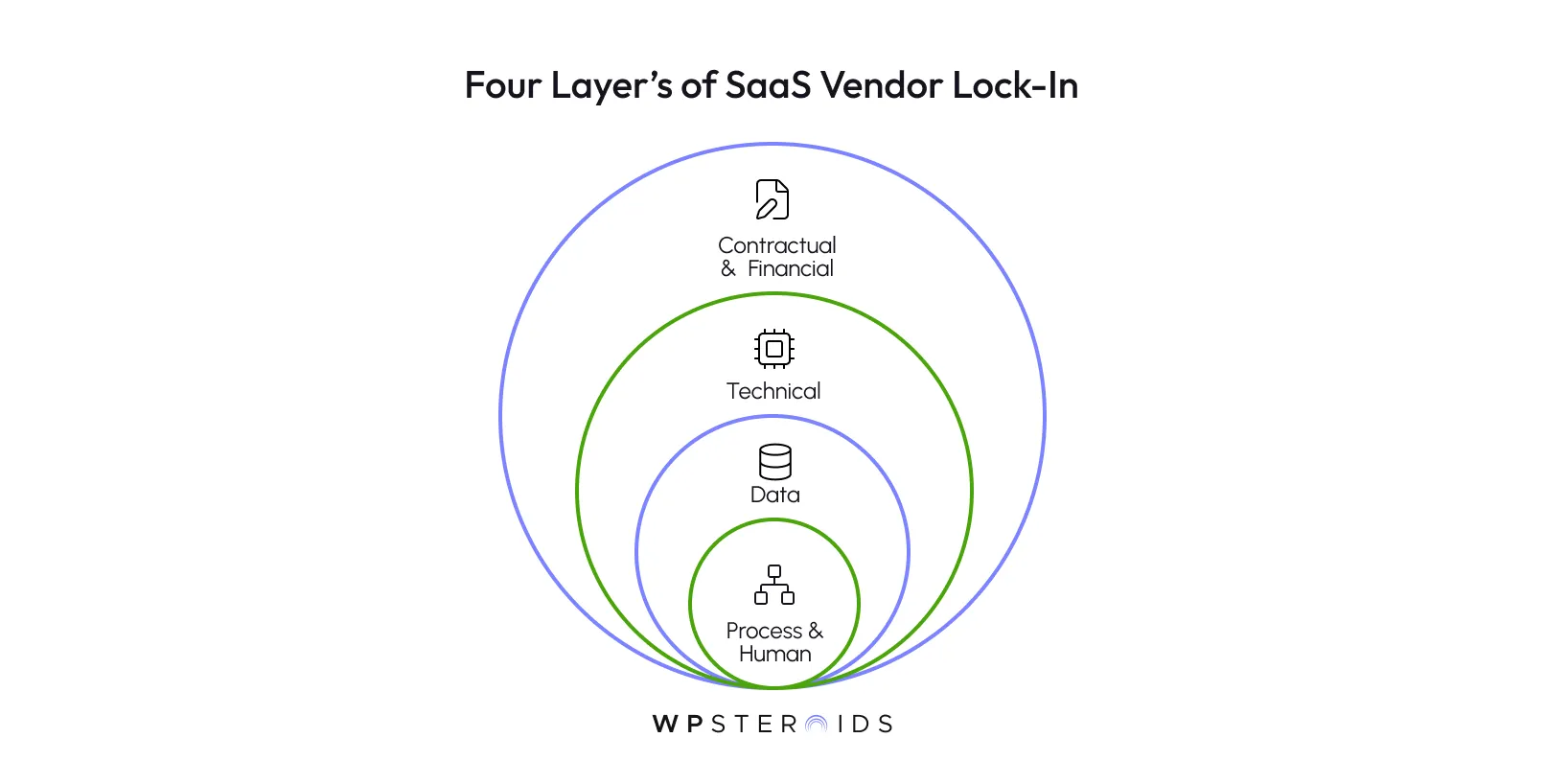
- Contractual & Financial Lock-in:
- This is the most visible layer, codified in the terms you sign. It begins with bundled pricing and steep initial discounts that incentivize adopting a vendor’s entire suite.
- While attractive upfront, this strategy ensures deep integration from day one. The real cost appears at renewal time, when pricing invariably increases.
- The vendor knows that the cost and disruption of leaving are now far greater than the price hike they are imposing.
- Punitive early termination clauses and complex licensing agreements that penalize partial adoption further solidify these financial handcuffs, making any objective cost-benefit analysis of switching prohibitively difficult.
- Technical Lock-in:
Deeper and far more restrictive is the technical lock-in. This is where a vendor’s platform is intentionally engineered to be incompatible with outside systems. It manifests in three ways:
- Proprietary APIs: Your teams build integrations using the vendor's custom APIs. Every man-hour invested in connecting these unique endpoints is a sunk cost that cannot be transferred to a new provider. You are building dependencies, not portable assets.
- Non-Standard Data Formats: Your corporate data—customer records, transaction histories, product information—is stored in a proprietary format. While you can often export this data, it's frequently delivered in a structure that is unusable without a significant and costly transformation project.
- Tightly-Coupled Architecture: This is the core of the problem. The platform’s components (e.g., CMS, CRM, commerce) are fused together. You cannot replace their underperforming analytics module with a best-of-breed solution because it would break the entire system. This architectural rigidity makes incremental modernization impossible.
- Data Lock-in:
- As your business grows, so does your data footprint within the vendor's ecosystem. This creates a powerful force known as "data gravity".
- The more customer, product, and operational data you accumulate in a single platform, the more momentum it gains, and the harder it becomes to pull away.
- A migration is no longer a simple export; it's a high-stakes data engineering project.
- You face the significant cost of extracting, transforming, and loading terabytes of business-critical information, all while facing the non-trivial risks of data corruption, loss, and operational downtime during the transition.
- Process & Human Lock-in
- The final, most subtle layer is the dependency you build within your own organization. Your teams' daily workflows become inseparable from the vendor's software.
- Marketing campaigns are designed around the platform’s specific capabilities; sales processes are hardwired into its CRM workflows.
- To switch providers means more than just a technical migration; it requires a massive change management initiative.
- The cost of retraining hundreds of employees and the associated dip in productivity is a real and substantial barrier, making the perceived stability of the status quo a powerful deterrent to necessary change.
How SaaS Vendor Lock-in Bleeds Revenue and Stifles Innovation
While the technical and contractual chains are strong, the real damage of SaaS vendor lock-in is found on your balance sheet and in your market position.
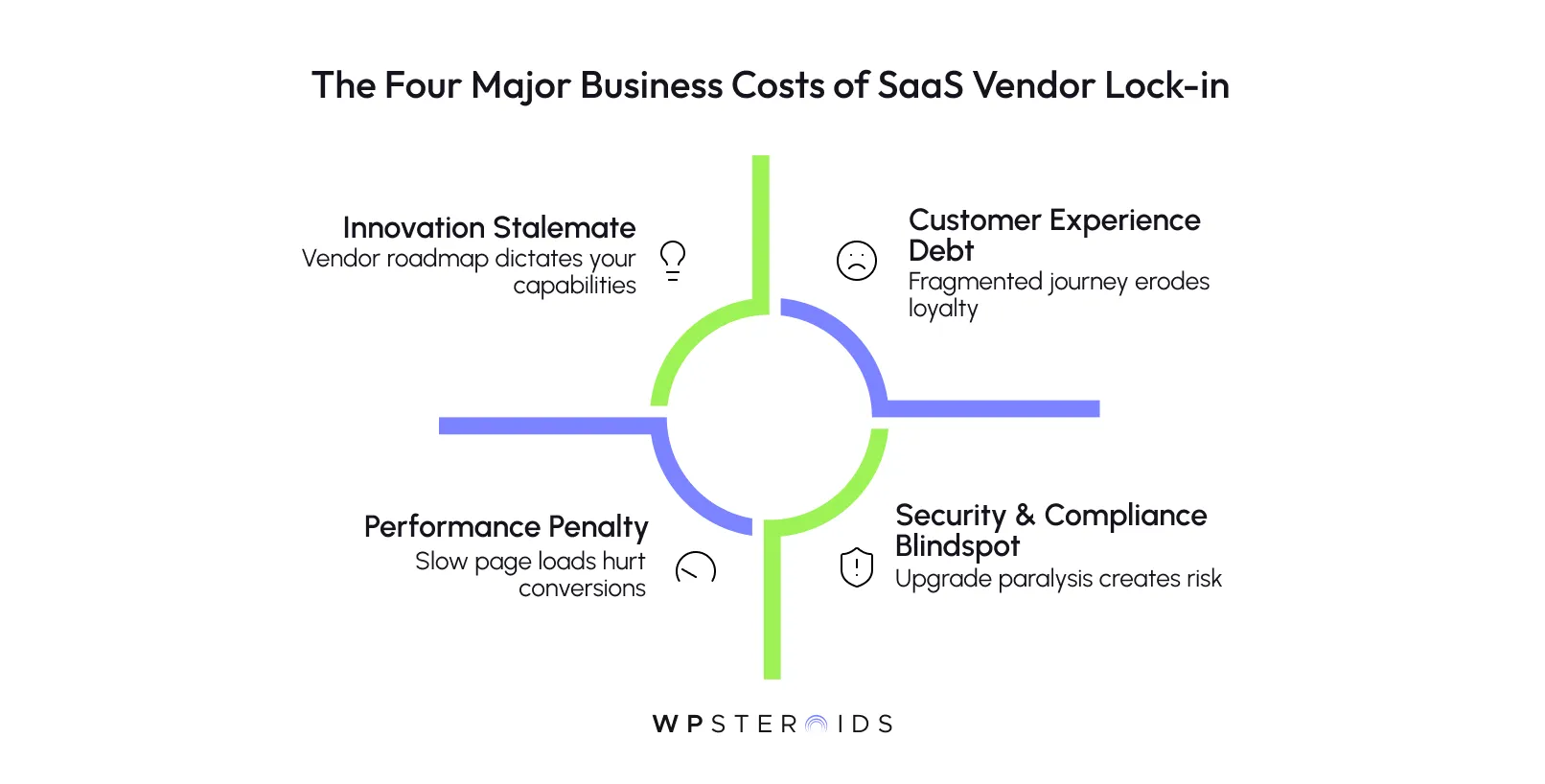
The Innovation Stalemate
When you are locked into a single vendor's suite, their product roadmap becomes your strategic ceiling. You are forced to operate with their "good enough" modules while more agile competitors are deploying best-of-breed solutions for critical functions like search, analytics, and personalization.
Every decision to integrate a superior new technology becomes a protracted and costly battle against the grain of your existing platform. This forces you to innovate at your vendor’s pace, not the market’s, effectively paying an "innovation tax" that benefits your competitors.
The Customer Experience Debt
A rigid, monolithic system is the enemy of a seamless customer journey. It creates disjointed experiences where the data from your commerce engine doesn't properly inform your marketing platform, and neither integrates cleanly with your customer service tools.
The result is a fragmented, frustrating experience for the end-user, which directly erodes loyalty and lifetime value. This "customer experience debt" accumulates over time, making it increasingly difficult to deliver the consistent, omnichannel journey that modern customers expect as a baseline.
The Performance Penalty
Monolithic SaaS platforms are notoriously bloated. This technical overhead translates into a direct performance penalty: slower page load times, poor Core Web Vitals, and a sluggish user experience.
In an era where a 100-millisecond delay can measurably decrease conversion rates, this is a tax on every dollar of your marketing spend. Poor performance not only drives customers away but also results in lower search engine rankings, reducing your organic reach.
Your platform’s inefficiency becomes a direct drag on revenue.
The Security & Compliance Blindspot
One of the most overlooked IT procurement risks is the upgrade paralysis that occurs in a locked-in environment. When a vendor releases a critical security patch or a necessary compliance update, applying it can be a monumental task.
This creates a permanent state of elevated risk, forcing a dangerous trade-off between operational stability and essential security.
From Monolithic Cages to a Composable Technology Stack
The alternative to accepting the limitations of SaaS vendor lock-in is not to find a marginally better monolithic provider. It is to fundamentally change the way you assemble your technology architecture.
This shift moves you from being a passive renter of a closed ecosystem to an active builder of an open, adaptable one. This is the essence of the composable paradigm.
Defining the Composable Philosophy
A composable stack is not a product you buy; it is an architectural philosophy you adopt. The core principle is simple: instead of relying on a single vendor to provide a suite of mediocre, pre-integrated tools, you select the best-of-breed solution for each specific business need and "compose" them into a unified whole.
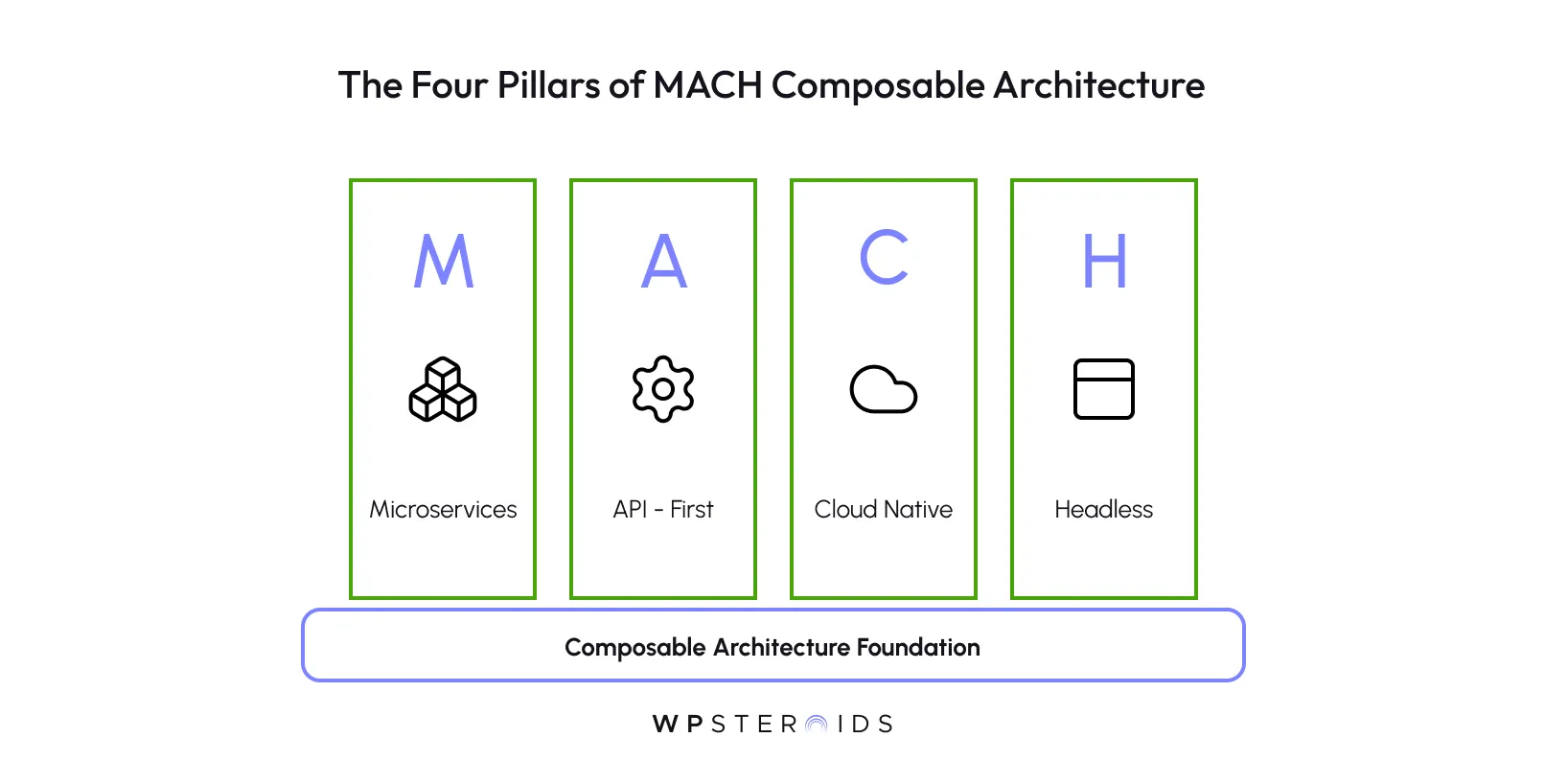
This approach is built on a set of technical standards designed to ensure seamless interoperability and prevent future lock-in. These are best defined by the MACH Alliance, which outlines the four pillars of a truly composable architecture:
- Microservices: Your architecture is composed of small, independent applications (services) that each perform a single business function—such as search, payment processing, or content delivery. Each can be developed, deployed, and scaled independently of the others.
- API-first: Every component is built with an API-first architecture. This means its capabilities are exposed through a well-documented Application Programming Interface, ensuring it can reliably communicate with any other service. It is a commitment to interoperability by design.
- Cloud-native: The infrastructure leverages the full potential of the cloud. This isn't just about hosting servers elsewhere; it's about using cloud-native applications and services that provide superior scalability, resilience, and on-demand resource allocation that legacy systems cannot match.
- Headless: The presentation layer (the "head" or front-end) is completely decoupled from the back-end business logic and content repository. This provides absolute freedom to design and deliver customer experiences across any channel—web, mobile app, kiosk, or IoT device—without being constrained by the back-end system.
A Head-to-Head Comparison
The strategic difference between these two models becomes clear when you compare their impact on business outcomes.
Composable vs. Monolithic
A monolithic architecture forces you to make a single, high-stakes decision on a vendor who will dictate your capabilities for the next five to ten years. A composable technology stack transforms this into a series of smaller, lower-risk decisions.
- Speed to Market: With a monolith, launching a new feature or entering a new market is dependent on your vendor’s development priorities. In a composable model, independent teams can build and deploy new services in parallel, dramatically accelerating your time to market.
- Adaptability: If a component in your monolithic suite—like the e-commerce engine—no longer meets your needs, you have no recourse. In a composable stack, you can surgically replace that single underperforming service with a better one without disrupting the rest of your operations.
- Total Cost of Ownership (TCO): Monolithic providers bundle licensing costs and often hide the true expense of customization and integration. A composable approach offers more transparent, pay-for-what-you-use pricing models and eliminates the costly process of trying to force-fit a rigid system to your unique business needs.
Headless vs. Traditional CMS
The concept of a headless architecture is a direct and powerful solution to the technical lock-in created by traditional Content Management Systems.
A traditional CMS dictates the entire digital experience, fusing content management, business logic, and front-end presentation into a single, inseparable block. This restricts you to their predefined templates and themes.
A headless CMS, by contrast, is solely focused on storing and organizing content. It then delivers this content via an API to any front-end system you choose to build. This separation provides complete control over the customer experience and allows you to use modern, high-performance front-end technologies.
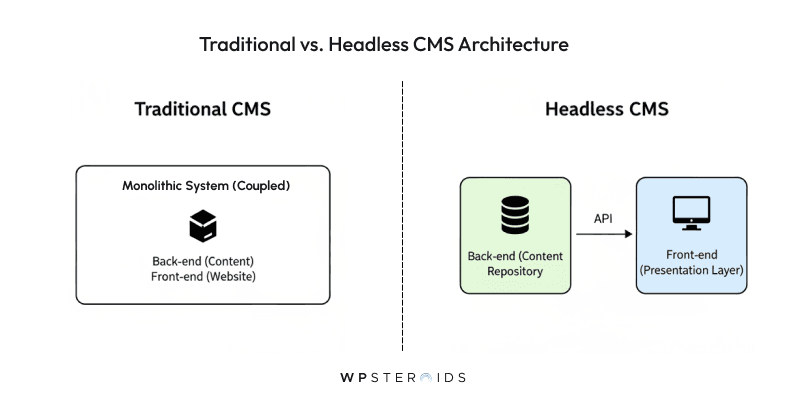
The same principle applies to headless commerce, which decouples your product catalog and checkout logic from the sales interface, enabling true omnichannel retail.
The Strategic Implementation Playbook: Your Roadmap to Freedom
Executing the shift from a monolithic to a composable architecture is not merely a technical migration; it is a strategic business transformation.
It demands a new model for building, managing, and evolving your digital assets. This is not about a high-risk, "rip-and-replace" project.
It is a deliberate and phased approach to reclaiming your technological independence and building a true competitive advantage.
Mastering the Digital Experience Orchestration Layer
If the microservices in your composable technology stack are best-in-class specialists, the orchestration layer is the strategic command center that directs their actions to execute a unified business goal.
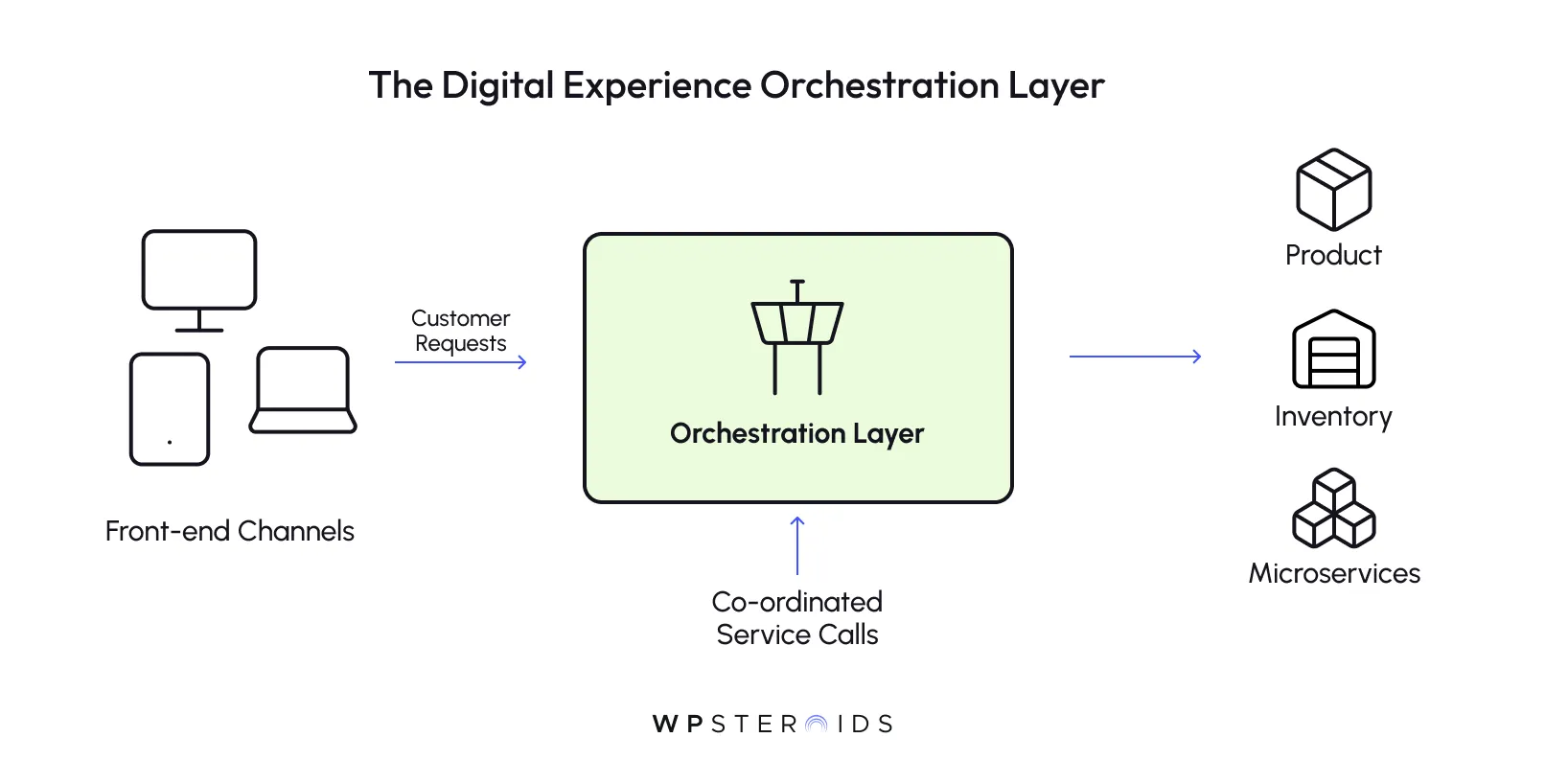
Overlooking or underinvesting in this component is the single most common and costly mistake in a composable transformation, turning a potential asset into a source of chaos.
- What It Is, In Business Terms: Think of it as the digital equivalent of an airport's air traffic control system. Your website, mobile app, and in-store kiosks (the airplanes) make requests for information or actions. The individual services—product catalog, inventory, pricing, promotions (the runways, gates, and ground crew)—are all highly efficient at their specific tasks. The orchestration layer is the control tower that manages the complex flow of requests, ensures there are no collisions, and sequences every action to provide a seamless, efficient journey for the end-user. It's the intelligent middleware that translates a simple customer request into a perfectly coordinated set of actions across your entire digital supply chain.
- Why It Is Strategically Critical: Without a well-designed orchestration layer, you don't have a composable stack; you have a disconnected collection of expensive tools. This layer is critical for several business reasons:
- Ensuring a Coherent Customer Journey: It centralizes business logic. This ensures a promotion is applied identically whether the customer is checking out via the mobile app or a web browser, preventing the disjointed experiences that erode customer trust.
- Accelerating Front-End Innovation: It insulates your customer-facing teams from back-end complexity. Your front-end developers can build new experiences by making a single, clean call to the orchestration layer, rather than having to understand and manage a dozen complex connections to different microservices. This decoupling allows them to innovate at twice the speed.
- Creating a Single Source of Truth: By consolidating data from multiple services before it reaches the customer, the orchestration layer can act as a single source of truth for the "state" of the customer's interaction, enabling more sophisticated personalization and analytics.
- Simplifying Security and Governance: It serves as a secure API gateway, a single chokepoint where you can enforce security policies, monitor traffic, and manage access rights across your entire suite of services.
- The Build vs. Buy Decision: The strategic importance of this layer naturally leads to a critical decision: do you build a custom orchestration solution or buy a commercial one? Building offers complete control but requires a significant investment in specialized engineering talent. Buying can accelerate your timeline but may introduce its own set of constraints. The right decision depends entirely on your organization's digital maturity, in-house capabilities, and long-term strategic goals.
Performance as a Feature: Why a Composable Stack is Inherently Faster
- The Architectural Speed Advantage: A headless architecture allows you to separate the user-facing "head" from the back-end "body." This enables the use of modern front-end rendering techniques that are simply not possible with a monolith:
- Static Site Generation (SSG): For content that doesn't change often (like a blog or marketing pages), the entire page can be pre-built and served instantly from a global Content Delivery Network (CDN). The result is near-zero load time.
- Server-Side Rendering (SSR) & Incremental Static Regeneration (ISR): For dynamic content (like e-commerce listings), pages can be rendered on-demand with fresh data but still be heavily cached at the edge, providing the perfect balance of speed and real-time information. A monolith, by contrast, often has to rebuild the entire page from scratch on its own server for every single visitor, creating a significant performance bottleneck.
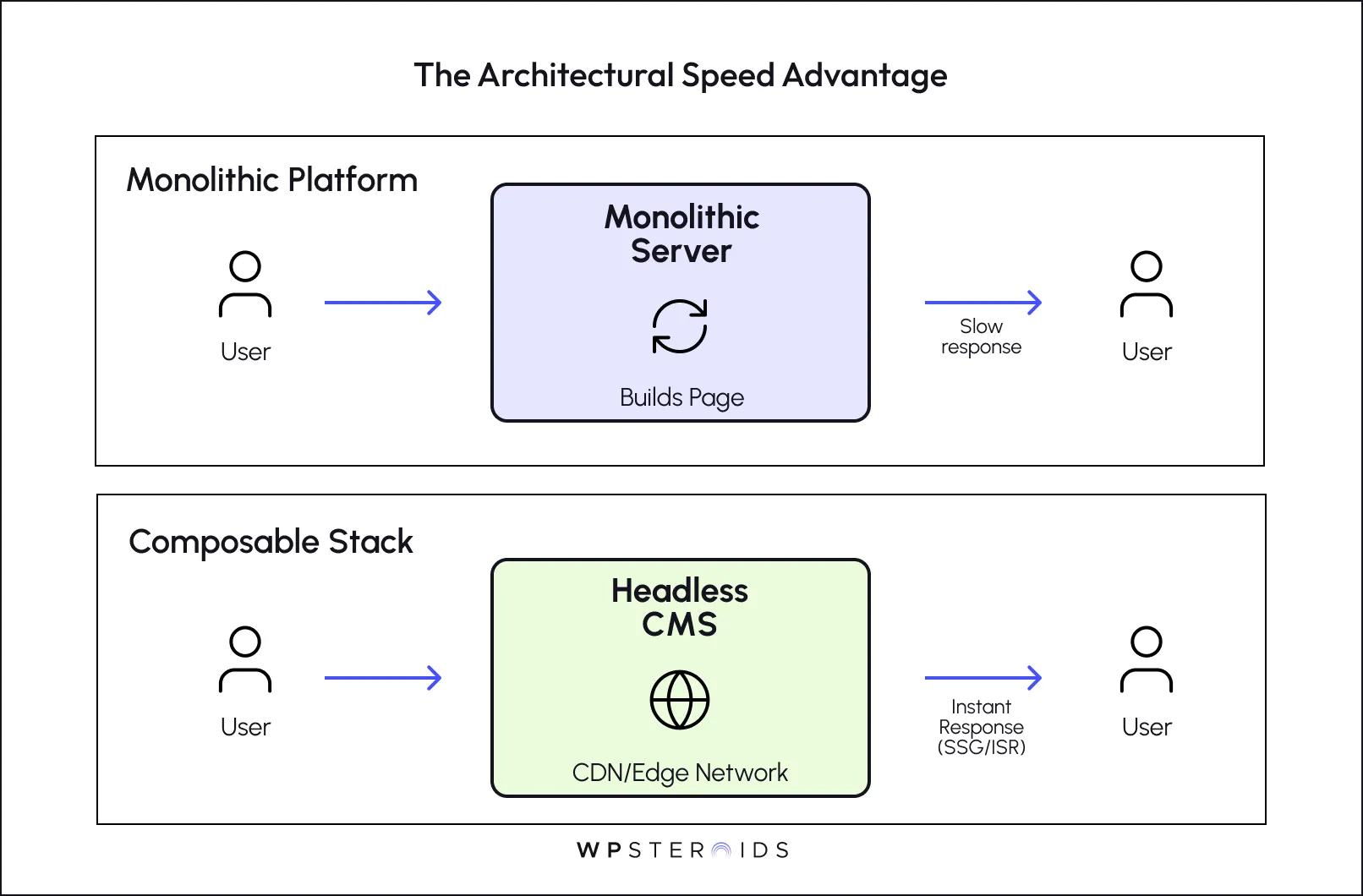
- Tangible Business Outcomes: This speed advantage translates directly into measurable KPIs. By enabling these modern front-end strategies, a composable architecture consistently delivers superior Google Core Web Vitals (CWV). This leads to higher search engine rankings, more organic traffic, and lower customer acquisition costs. Furthermore, the fluid, instant-feeling user experience directly reduces bounce rates and increases conversion rates, maximizing the ROI of your marketing efforts.
The Phased Migration Framework: How to Avoid a "Big Bang" Disaster
The most daunting part of escaping vendor lock-in is the migration itself. However, the fear of a massive, high-risk, "all-at-once" project is unfounded.
A successful transition is a methodical, phased process designed to de-risk the project, deliver incremental value, and build organizational momentum. This is the practical vendor lock-in solution.
- Step 1: Strategic Audit and Domain Mapping: Before writing a line of code, conduct a strategic audit of your existing monolithic platform and the business processes it supports. The goal is to create a "domain map" of your business capabilities—things like "product discovery," "inventory management," and "customer support." Identify which of these domains are causing the most friction, offer the greatest potential for improvement, or represent the biggest strategic bottleneck. This audit forms the basis of your migration roadmap.
- Step 2: Apply the "Strangler Fig" Pattern: This architectural pattern is the key to a safe migration. Instead of replacing the monolith, you strategically "strangle" it over time.
- Your First Move: Choose a single, high-impact, relatively low-risk domain from your map—for example, your company blog or product detail pages. Rebuild this capability using a modern headless CMS and a new, high-performance front-end. This new service runs in parallel with the old system, routing traffic for that specific function to the new service.
- Demonstrate Value, Build Momentum: This first win is critical. The marketing team can now publish content in minutes instead of days. The new blog's Core Web Vitals score jumps into the "Good" category, leading to a measurable uptick in organic traffic. This success builds the business case and the internal expertise for tackling the next domain on your roadmap. Over months or years, you systematically replace the monolith's functions until it is no longer business-critical and can be safely retired.
- Step 3: Mandate Data Portability and Open Standards: This is the core principle of a long-term IT strategy that guarantees you will never be locked in again. For every new service you procure or build, you must enforce a strict policy of interoperability.
- This means demanding well-documented, standards-based APIs (REST or GraphQL), insisting on data formats like JSON, and using open protocols for authentication (like OAuth). Prioritizing open standards ensures that every component in your stack is, by design, replaceable. This shifts the power dynamic from the vendor to you, fostering a competitive environment where providers must continually earn your business through value, not through lock-in.
- Step 4: Evolve Your Governance and Team Structure: A technological shift of this magnitude requires a corresponding organizational shift. Monolithic systems encourage siloed teams (the "e-commerce team," the "CMS team"). A composable architecture thrives with cross-functional teams organized around business capabilities (the "product discovery" team, the "checkout experience" team). You must establish a clear governance model to manage your growing portfolio of services, ensuring consistency, security, and reusability across the enterprise.
Future-Proofing Your Enterprise: Agility, AI, and Technology Independence
The decision to move toward a composable architecture is ultimately a decision about the future of your business. It is about building an enterprise that is not only efficient today but is structurally prepared to adapt and win tomorrow.
The primary long-term benefits are a permanent increase in operational agility and the freedom to leverage new technology as it emerges.
Building for Agility in Software Development
The most immediate and transformative outcome of a composable architecture is the elimination of development bottlenecks. Monolithic systems create queues; a composable stack creates parallel work streams.
This is a direct result of the decoupled architecture. Your front-end development team, responsible for the customer experience, can build and test a new product launch page without waiting for the back-end team to finish provisioning the database or updating the promotions engine.
As long as both teams agree on the API contract—the set of rules for how their independent services will communicate—they can work simultaneously.
For the business, this translates into a dramatic compression of the time between a strategic decision and its market execution. A new digital product or feature that would have taken six to nine months of carefully sequenced, fragile development in a monolithic world can now be delivered in a single quarter.
Creating an AI-Ready Foundation
Businesses are faced with a critical choice: wait for your all-in-one vendor to slowly build and release their version of an AI feature, or have the freedom to integrate the best-in-class AI solution the moment it becomes available.
A composable stack is, by design, a platform for pluggable innovation.
- When a superior AI-powered search algorithm emerges, you can integrate it as a new microservice.
- When a generative AI tool for hyper-personalized marketing copy proves its ROI, you can connect it to your headless CMS via an API.
- When a new analytics platform offers predictive insights your current tool lacks, you can swap it in without disrupting your entire data pipeline.
This ability to continuously integrate new capabilities is the essence of building future-proof technology.
You are no longer betting your future on a single vendor's roadmap. Instead, you are building an agile, adaptable enterprise architecture that can absorb and leverage innovation in digital platforms from any source.
This is the ultimate form of technology independence: the power to choose the best tools for your business, always.
Reclaiming Your Technological Destiny
Accepting the constraints of SaaS vendor lock-in is no longer a cost of doing business; it is a strategic decision to operate at a permanent disadvantage.
The journey from a rigid, monolithic past to a flexible, composable future is therefore not merely a technical upgrade—it is a fundamental business imperative for any organization serious about competing on innovation and customer experience.
By embracing a composable technology stack, built on a foundation of headless architecture and managed by a deliberate orchestration layer, you are not just buying new tools. You are fundamentally re-architecting your business for speed, agility, and resilience.
This is the definitive path to reclaiming your technology independence, transforming your IT department from a cost center into the primary engine of your company’s growth.
Embarking on this digital transformation is one of the most impactful decisions a modern enterprise can make. It requires a clear vision, a pragmatic roadmap, and deep architectural expertise to execute successfully.
If your organization is ready to turn its technology stack from a strategic liability into your most potent competitive advantage, our team of enterprise architects is ready to help you craft the strategy and navigate the complexities of implementation.