Driving Digital Performance for a Digital Media Brand
Headless CMS scales and improves WPWhiteBoard’s content distribution, flexibility, and personalization
Adeeb Malik
Are your development teams constantly bogged down by the clunky limitations of your current CMS on ambitious client projects? Do you find yourself struggling to prove the long-term value of a technology investment beyond the initial website launch?
If you're nodding along, you're facing a question that has moved from the developer's desk straight into the boardroom: Is the pain of a major tech switch actually worth the financial gain for my agency?
You’ve heard the term "headless" thrown around, but it probably sounds like a costly, complex nightmare that you don’t have time for. The good news is, you don’t need to be a developer to understand the business case.
For digital agencies, the real ROI of switching to a headless CMS is found by moving beyond simple cost savings.
It lies in transforming client content into a reusable asset, enabling faster time-to-market for omnichannel experiences, significantly improving developer efficiency, and ultimately creating a more scalable and profitable service model for managing multiple client projects.
If you feel like your team is running faster just to stay in the same place, you’re not imagining things. As client demands grow for omnichannel campaigns, personalized experiences, and lightning-fast updates, the monolithic nature of traditional CMS platforms creates a significant bottleneck.
This isn’t just a minor annoyance for your developers; it's a direct threat to your agency's growth and profitability.
And you are not alone in feeling this strain. The problem is industry-wide.
A lack of a centralized content hub and disconnected technologies—the very foundation of most traditional CMS platforms. This isn't just a workflow issue; it's a full-blown content scaling crisis, and chances are, your CMS is at the heart of it.
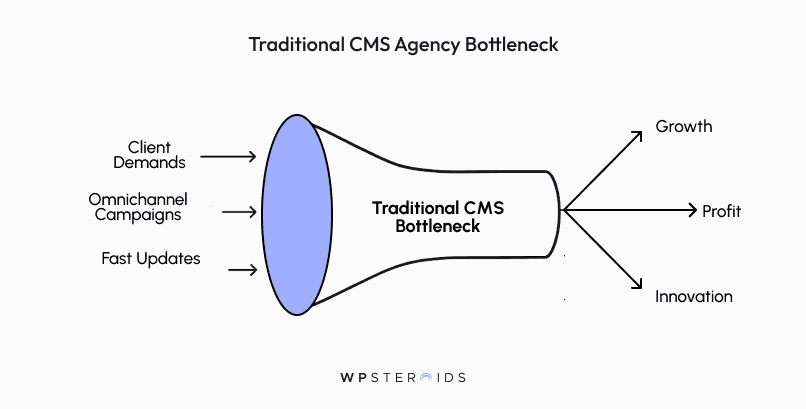
This crisis in the management of content has a direct and painful impact on your agency's bottom line.
Think about the last time a client asked for a feature that seemed simple on the surface but required hours of custom workarounds from your developers. These scenarios add up, leading to very real costs:
Ultimately, this inflexibility makes it nearly impossible to keep your clients ahead of their competition.
The fundamental architecture of traditional CMS platforms—a single system where the content and the design are fused together—was built for a simpler web. Today, it’s a liability.
To understand the solution, we first need to demystify the technology. Don't worry, this is simpler than it sounds.
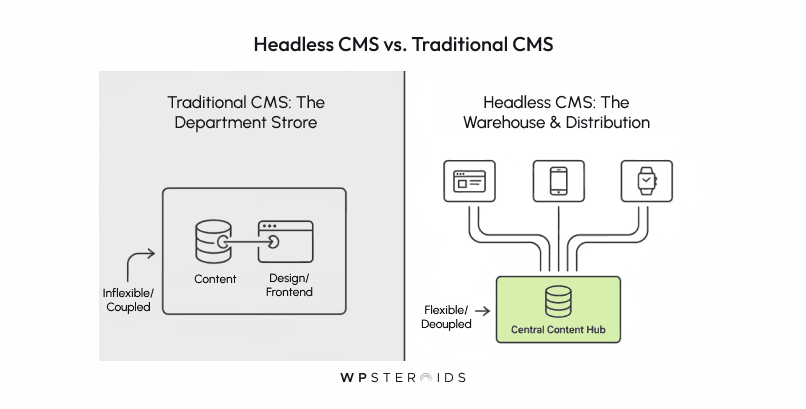
A headless CMS is a content management system that fundamentally separates your content repository (the "body") from the presentation layer (the "head"). In simple terms, it manages all your text, images, and data in the backend as pure, structured content.
This content is then made available through an API, which allows it to be delivered and beautifully displayed on any frontend you can imagine—a website, a mobile app, an in-store kiosk, or even a smartwatch.
To make this crystal clear, let's use an analogy based on a business model you already know well:
This separation is the crucial difference between traditional vs headless CMS models. It frees your valuable content from being trapped inside a single website design.
The shift toward headless isn't happening just for the sake of new technology. It's a direct response to two powerful forces: evolving client demands and the agency's desperate need for greater efficiency.
Clients no longer just want a website; they want a true omnichannel presence. A headless CMS can deliver on this promise in a way that traditional systems simply can't. It allows a single piece of content—a product description, a blog post, a customer testimonial—to be created once and then seamlessly deployed across platforms.
For your agency, this architecture is a game-changer. It frees your developers from the rigid frontend restrictions of monolithic systems. They can use the best, most modern frameworks to build faster, more secure, and more engaging user experiences.
And a headless CMS can do this while streamlining your content team's workflow. This isn't just a technical upgrade; it's a new way of working that gives you a powerful competitive advantage for winning and retaining the best clients.
For decades, the digital agency model has been built around "the big redesign." A client's website gets old, you pitch a new one, and the cycle repeats. In this model, the content is often treated as a disposable component—something to be painstakingly migrated from one rigid template to another every few years.
This approach is not only inefficient, but it also fundamentally misunderstands the value of your content.
This is where the most profound shift in thinking—and the most significant ROI—comes into play. It’s about moving beyond the one-time project and changing how you and, importantly, your clients, view their content for the future.
The real long-term ROI of a headless CMS isn't just in developer speed; it's in transforming a client's content from a disposable website expense into a structured, reusable business asset.
You're not just building a website; you're building a client's "content engine" for the next decade.
Think about that. You are no longer selling just a website. You are building the single source of truth for your client's most valuable marketing asset: their content.
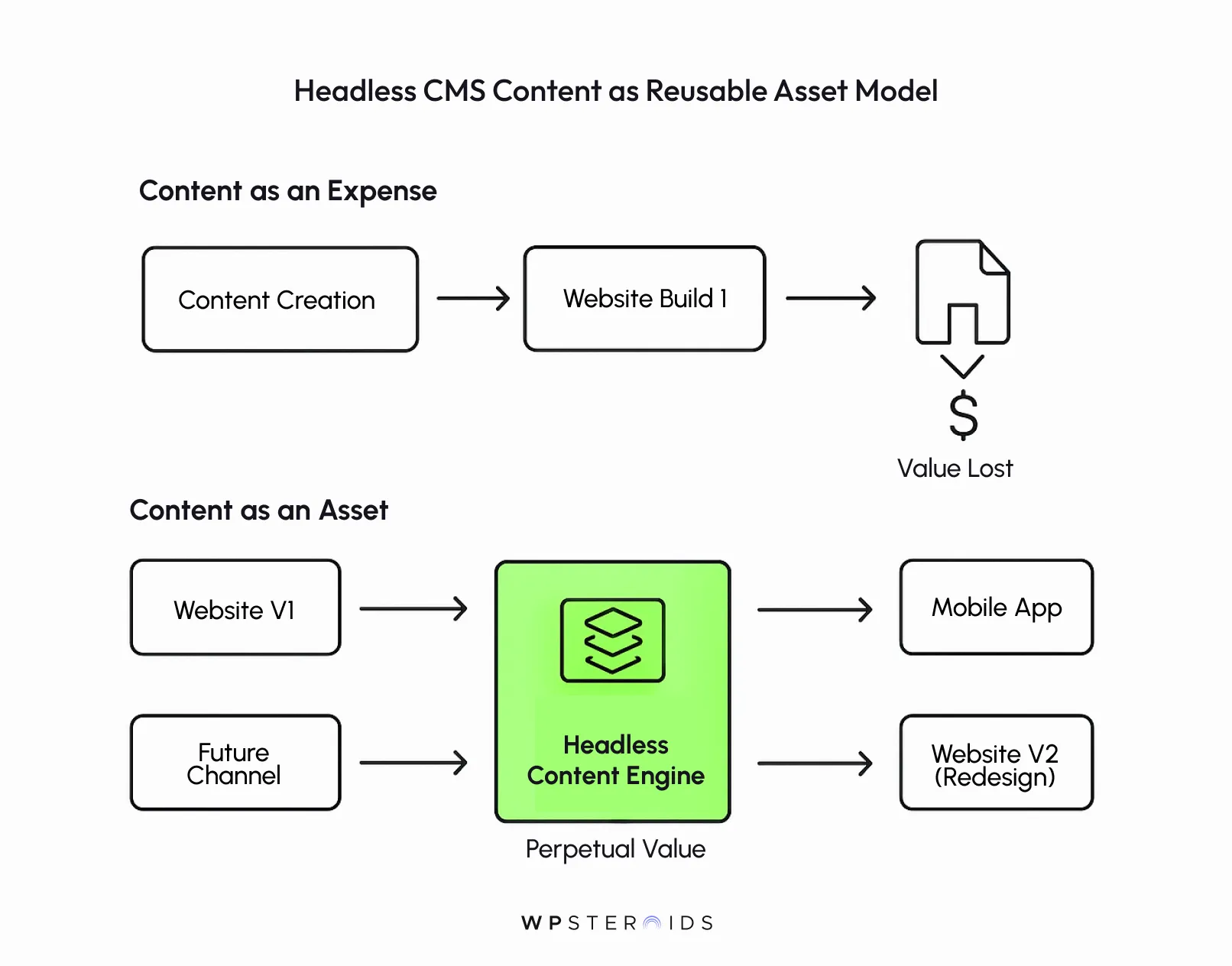
By creating this central content engine, you are fundamentally future-proofing your client's investment. When the next design trend emerges or they need to launch a new mobile app, you don't have to start from zero.
The content is already structured, approved, and ready to be deployed. The project becomes a much smaller, faster, and more affordable "re-skinning" of the frontend, not a massive backend overhaul.
This is a game-changer for your agency's business model. It allows you to:
This model moves you from a reactive, project-based relationship to a proactive, partnership-driven one, creating stickier clients and more predictable, high-value recurring revenue.
Shifting to a future-proof asset model is the long-term strategic prize. But the justification for the switch starts with immediate, measurable financial gains.
The real ROI of headless isn't a vague promise; it's a series of concrete improvements to your operations that directly impact your agency's profitability. Let's break down the calculations.
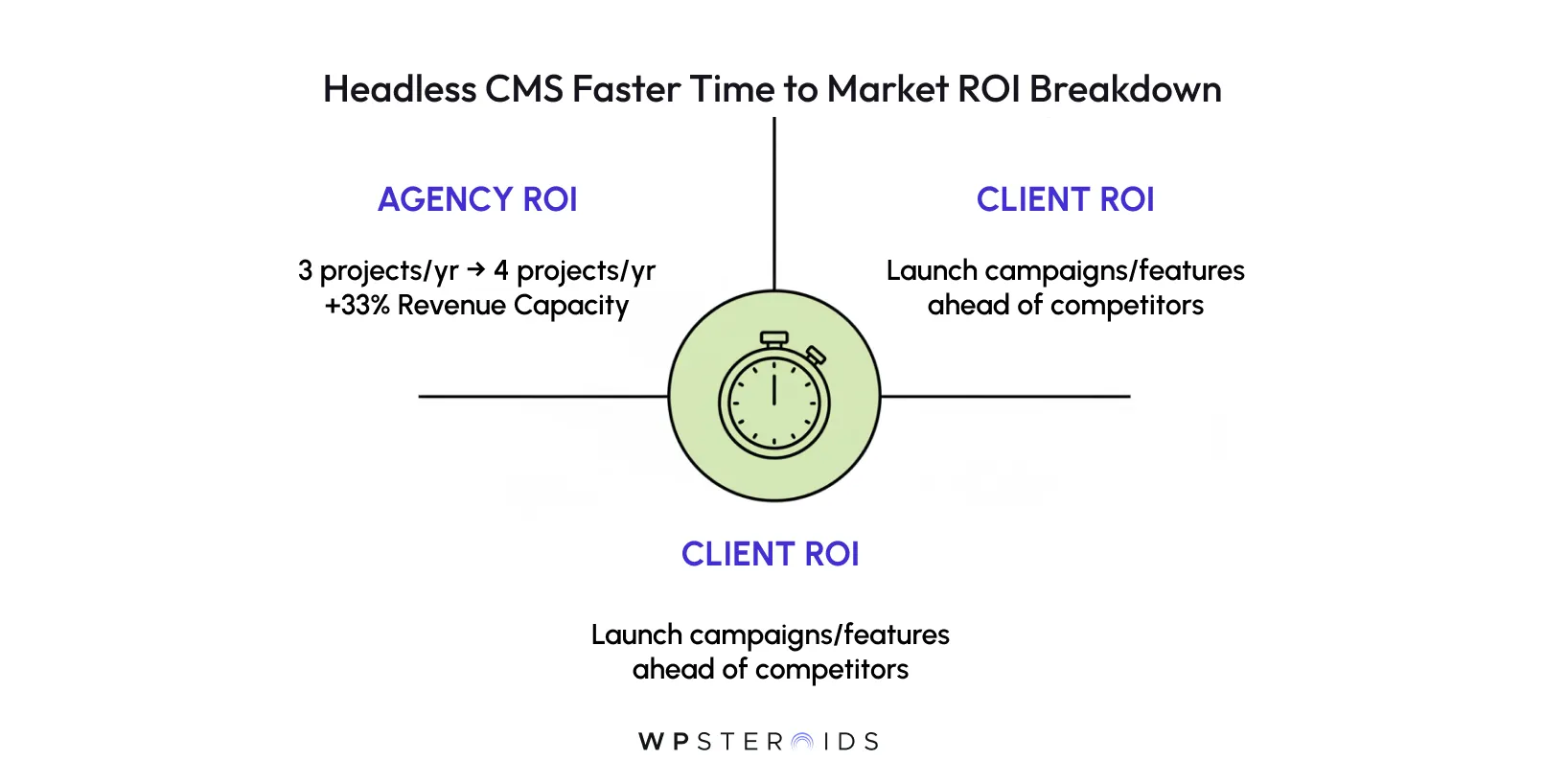
Think about it in simple terms. Let's say your average project takes four months from kickoff to launch. A headless architecture, by separating frontend and backend development, can realistically cut that timeline by 25%, bringing it down to three months.
Suddenly, the same team that was delivering three major projects a year can now deliver four. That's a 33% increase in revenue capacity without adding a single person to your payroll.
For your clients, this speed is a powerful competitive advantage. It means they can launch a new product campaign, respond to a market shift, or roll out a new feature weeks or months ahead of their competitors.
That's a value proposition you can quantify and sell at a premium, boosting not just your efficiency but the perceived value of your work.
The improved content delivery speed directly translates to business agility for your clients and increased throughput for your agency.
One of the most significant operational drains in a traditional CMS workflow is the linear, dependent process. Content creators wait for developers, who wait for designers, who wait for backend changes. A headless architecture shatters this model.
By decoupling the content from the presentation, you enable parallel workflows:
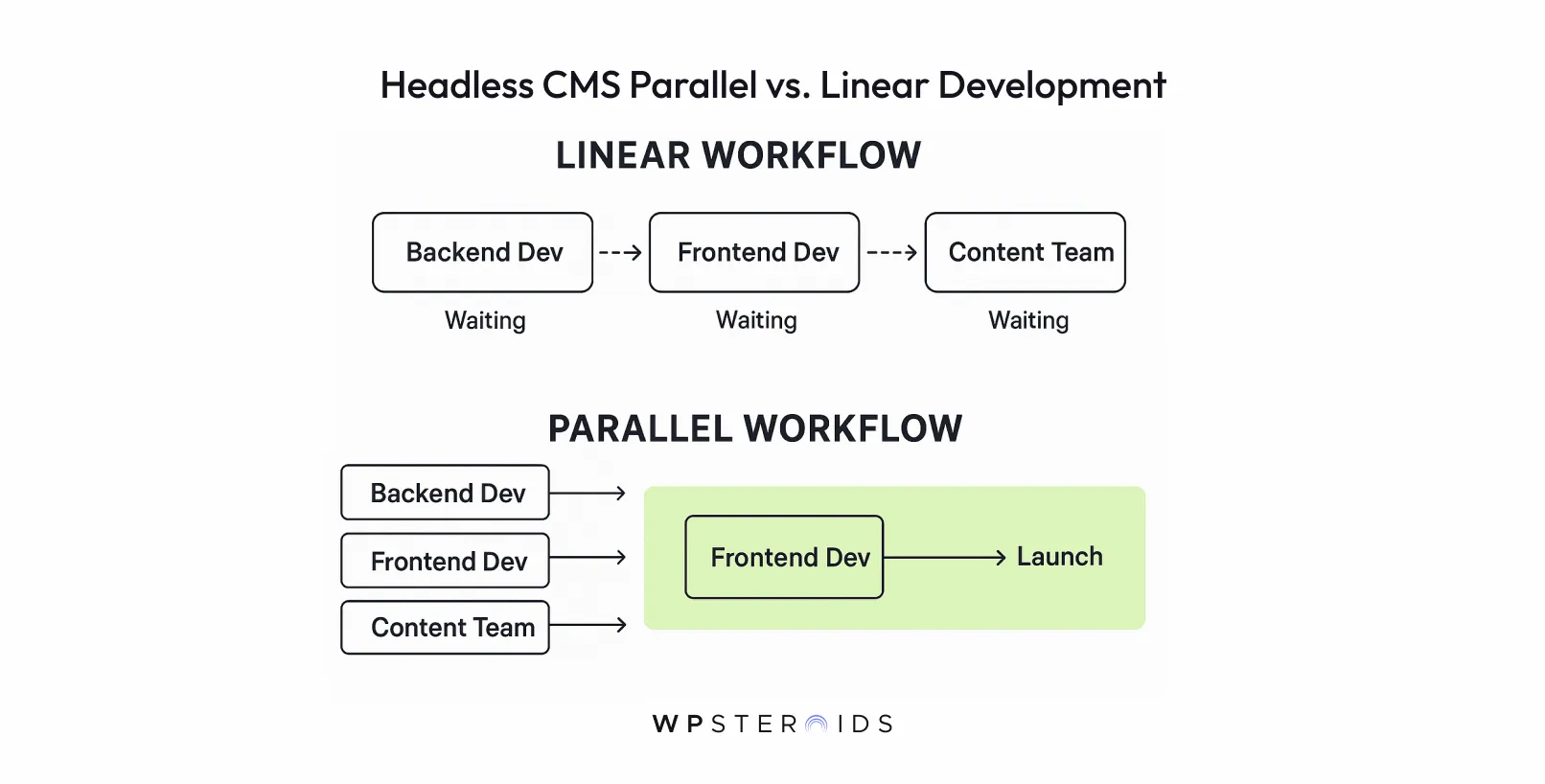
The result is a dramatic reduction in the billable hours required to complete a project. That efficiency gain drops directly to your bottom line, boosting the profitability of every single project you run.
Imagine a client needs to update a promotion across their main website, their mobile app, and a digital display in their stores. In a traditional setup, this could mean three separate, manual updates—a tedious and error-prone process.
With headless, you update the promotional content once in the central repository, and it instantly populates across all channels.
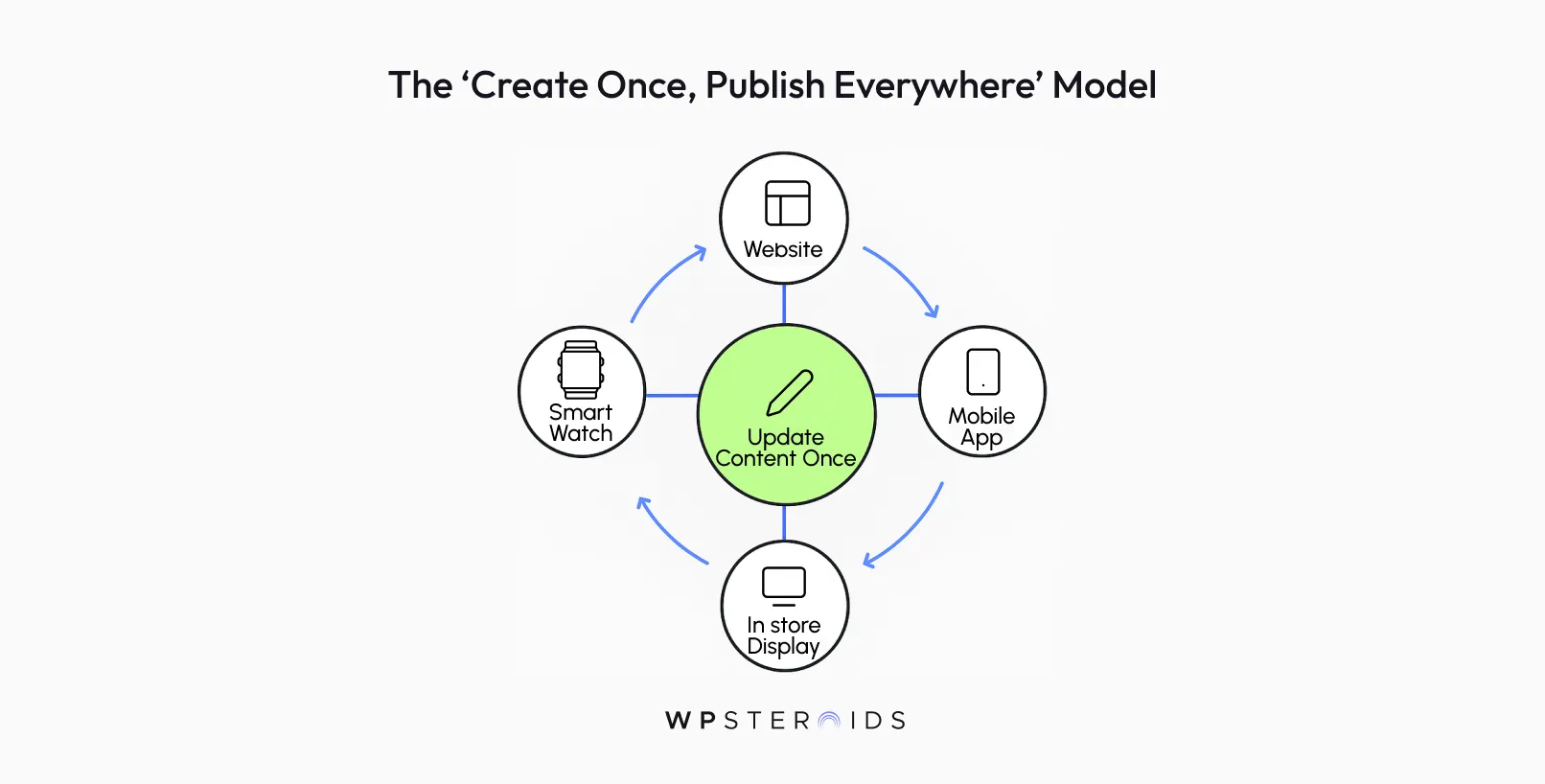
This level of optimization with headless CMS radically reduces the ongoing overhead of content management. It frees up your team and your clients from mundane tasks, allowing them to focus on high-value work.
Furthermore, the performance benefits of modern frontends powered by a headless CMS—blazing-fast load times and seamless user experiences—have a direct impact on SEO rankings, user engagement, and, most importantly, conversion rates.
When you tie faster performance and easier content management directly to client revenue, you create a powerful argument to maximize ROI.
While internal efficiencies boost your profit margins on existing work, the most exciting ROI in headless comes from how it transforms your agency's position in the market.
This is where the investment stops being a cost-saving measure and becomes a powerful engine for growth.
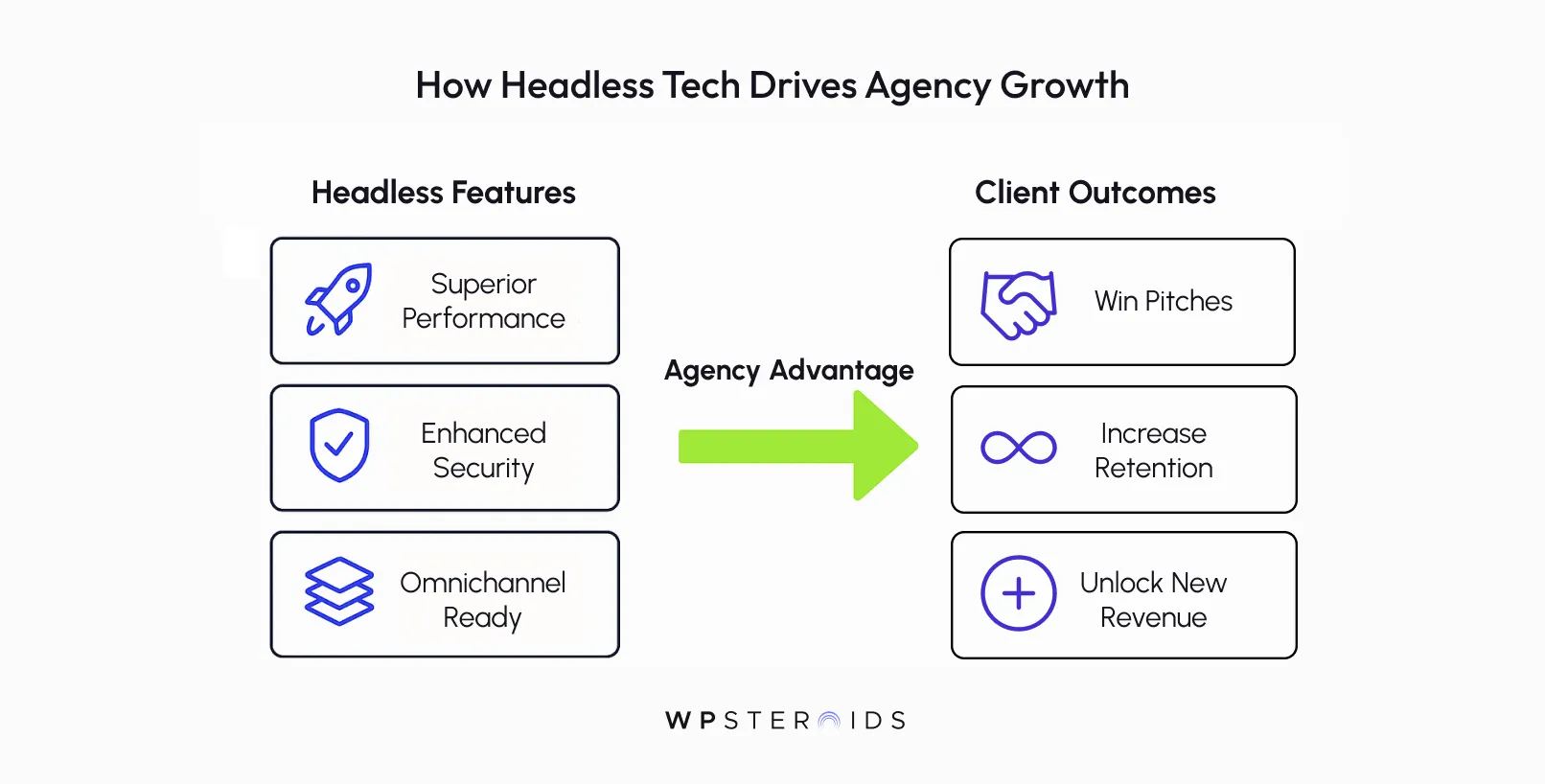
In a competitive new business pitch, you're no longer just selling a website design; you're selling a superior technology foundation.
Design agencies that have mastered headless can confidently promise benefits that their competitors using traditional systems struggle to deliver:
This is a powerful differentiator that moves the conversation from aesthetics to strategic value.
But the real magic for your agency's stability happens after the launch. Client retention is everything, and headless architecture makes your agency incredibly sticky.
When a client wants a frontend redesign in two years, the project is drastically smaller and less expensive.
There's no painful content migration. When they want to add a new channel, you're the indispensable partner who can make it happen quickly.
This future-proof foundation means their clients have little reason to look elsewhere, securing your long-term revenue.
Now, let's talk about your own scalability. As your agency grows, managing a portfolio of disparate, clunky CMS installs is an operational nightmare.
Each one has its own theme, its own collection of plugins, and its own unique set of problems. It’s inefficient and incredibly difficult to maintain quality.
A headless approach provides a path to sanity and scale. It allows you to standardize your backend stack and development processes while offering complete frontend freedom for each client. This creates massive efficiencies of scale across all your client projects.
Imagine a world where your development team isn't re-learning a new "all-in-one" CMS for every project. They work with a consistent, modern stack they know inside and out.
This consistency dramatically reduces onboarding time for new developers, streamlines maintenance across your entire client roster, and improves the quality and reliability of your service.
You build better products, faster, for all your clients—the ultimate recipe for profitable growth.
Alright, let's talk about the elephant in the room: the cost. A new technology platform is a significant decision, and you need a clear-eyed view of the investment required.
The goal here isn't to pretend it's cheap, but to accurately frame the costs against the long-term value, giving you a true picture of the ROI in headless CMS.
Let's be direct: transitioning to a headless CMS often involves a higher initial cash outlay than spinning up a new website with a pre-built theme on a traditional platform. It's crucial, however, to categorize this correctly.
It’s not just an operational expense; it's a capital investment in a more flexible and scalable foundation for your agency and your clients.
The primary upfront costs typically fall into three buckets:
While the initial invoice might look higher, you are buying total design freedom, superior performance, and the long-term scalability we've discussed.
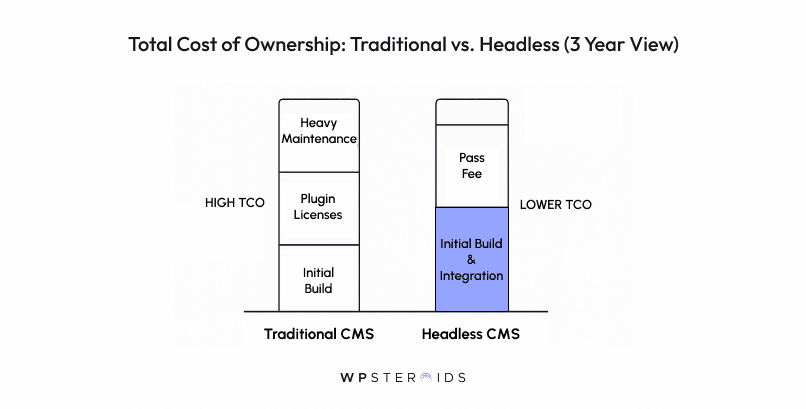
But the real story is in the costs you eliminate:
Because a headless architecture is inherently more secure and stable, the need for constant, reactive maintenance plummets.
When you calculate the Total Cost of Ownership (TCO) over a two-to-three-year period, the headless model frequently proves to be less expensive.
A successful transition is about being prepared. Ignoring the potential pitfalls is how projects go off the rails and how the ROI of going headless gets compromised. Here are the three most common challenges you should anticipate:
You can’t manage what you don’t measure. To truly justify the switch and understand the real ROI of headless CMS, you need to move beyond feelings and anecdotes. You need hard data.
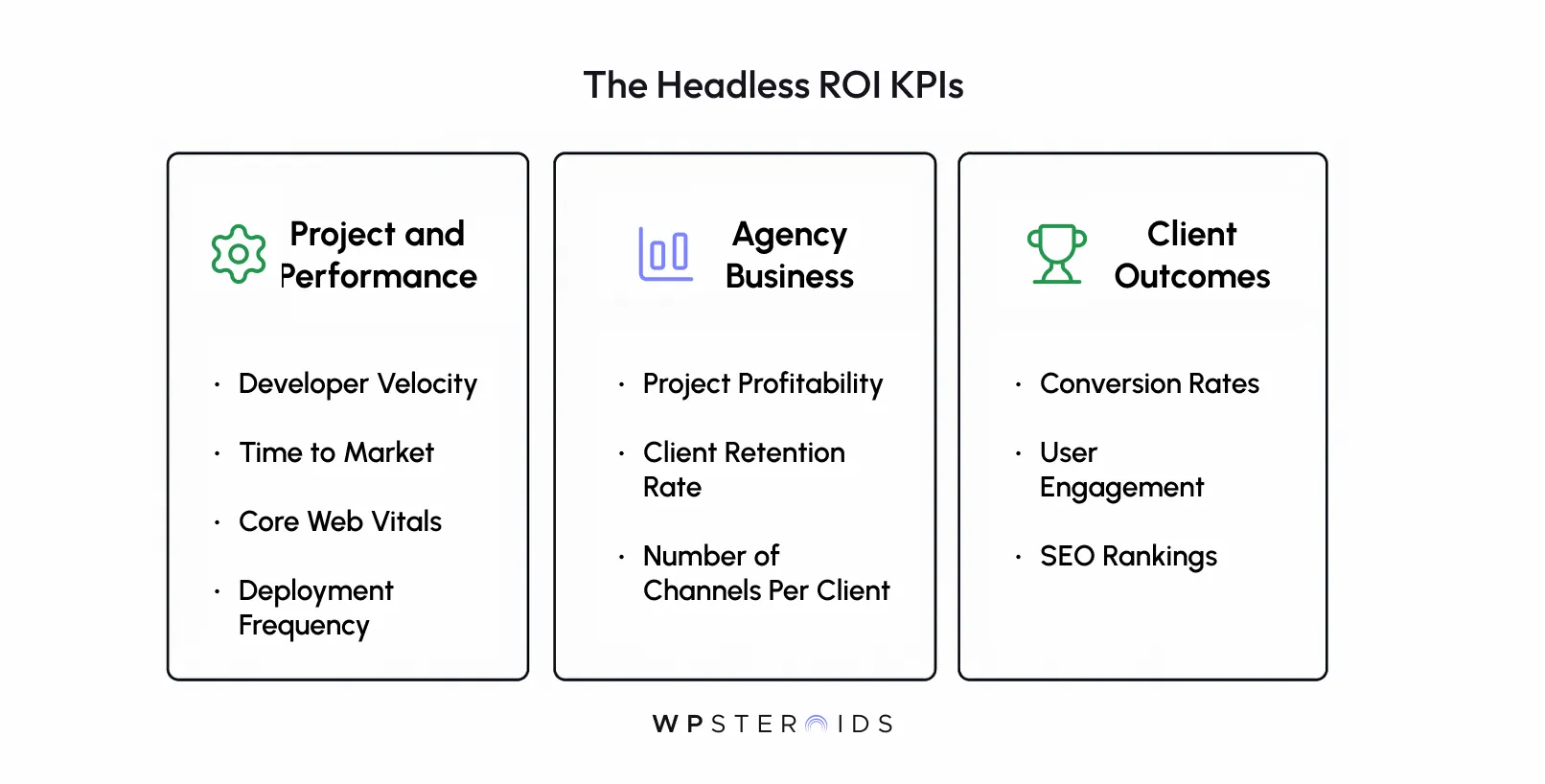
By tracking specific Key Performance Indicators (KPIs) before and after the transition, you can build an undeniable business case for your team, your stakeholders, and your clients.
This is where the rubber meets the road. These metrics give you a direct, project-level view of the efficiencies gained.
To get a clear picture, you must benchmark these KPIs on your current traditional CMS projects so you have a baseline for comparison.
Project metrics are fantastic, but you need to connect them to the health of your agency's business.
These KPIs zoom out to show the strategic impact on your profitability and growth.
If you want to find out how switching to a headless CMS can impact your agency, starting to track these KPIs today is the single most important first step you can take.
This isn't just a platform switch; it's a strategic shift in how your agency designs and builds digital experiences for the long term. By embracing a headless, composable architecture, you position your agency at the forefront of the industry.
You become equipped to deliver the fast, flexible, and scalable solutions that high-value clients are no longer just asking for, but demanding.
The data and the market trends are clear: the operational drag and creative limitations of traditional systems are a growing liability.
You're now ready to build experiences with headless cms that leverage the best of modern technology, from powerful frontend frameworks to performance enhancers like edge computing, giving you the power to truly unlock your site's potential and, more importantly, your clients'.
The real question is no longer if your agency can afford the investment of switching to headless, but rather, how long you can afford to wait while your competitors make the leap.
Ready to move from theory to action? Book a discovery call with our team to get a personalized breakdown of how a headless CMS can transform your agency's profitability and future-proof your most valuable client projects.
Is headless CMS the future?
For any agency that wants to build modern, high-performance digital experiences, the answer is a definitive yes. The internet is no longer just about websites; it's about delivering content seamlessly to apps, smart devices, and platforms that don't even exist yet. Headless architecture is built for this omnichannel future, while traditional CMS was built for the past.
Why are agencies considering switching to a headless CMS?
Agencies are switching to solve critical business problems that traditional systems can't fix. They're motivated by the need to increase developer efficiency, accelerate project timelines, reduce operational headaches, and meet growing client demands for faster, more secure, and more flexible digital platforms.
How does a headless CMS impact ROI compared to a traditional CMS?
A headless CMS delivers a higher and more sustainable ROI. The return from a traditional CMS is often tied to a single website launch. In contrast, a headless CMS provides ongoing returns through dramatically improved efficiency on every subsequent project, reduced long-term maintenance costs, and the ability to reuse content across new channels, which creates new revenue opportunities.
What are the short-term vs. long-term ROI benefits of adopting a headless CMS?
Short-term ROI is seen in faster project delivery, improved site performance (better Core Web Vitals), and higher profitability per project due to fewer development hours. The long-term ROI is even more significant: higher client retention rates, new revenue from omnichannel projects, and a more scalable operational model for the entire agency.
How does a headless CMS reduce development and maintenance costs for agencies?
It separates the frontend from the backend, allowing developers to use faster, more efficient modern tools. This speeds up the initial build and simplifies future updates. Because the architecture is more secure and stable by nature, ongoing maintenance costs plummet, as you spend far less time on security patching and troubleshooting conflicting plugins.
Can switching to a headless CMS increase revenue opportunities for agencies?
Absolutely. It's a primary driver of agency growth. A headless foundation allows you to move beyond selling "websites" and start selling higher-value strategic solutions, including mobile apps, IoT experiences, and other omnichannel projects. This capability makes you a more attractive partner for sophisticated, high-budget clients.
How do agencies measure ROI after migrating to a headless CMS?
The most effective way is to benchmark key metrics before the switch and track them consistently after. This includes measuring project profitability, developer velocity (the time it takes to complete common tasks), average project time-to-market, and client retention rates.
What KPIs should agencies track to evaluate ROI from headless CMS adoption?
Focus on a mix of project, performance, and business metrics. Key KPIs include:
How does a headless CMS support scalability for growing agencies?
It allows an agency to standardize its backend technology and processes while giving complete creative freedom on the frontend for each client. This consistency creates huge efficiencies of scale, making it easier to manage dozens of client projects, onboard new developers, and maintain a high standard of quality as you grow.
What role does omnichannel content delivery play in ROI?
It plays a massive role. The ability to "create once, publish everywhere" drastically cuts down the time and expense of managing a client's content across their website, app, email campaigns, and other digital touchpoints. This operational efficiency directly boosts your profit margins and provides enormous, tangible value to your clients.
What are the upfront costs of migrating to a headless CMS?
The primary upfront costs are the subscription to the headless CMS platform, the initial development labor required to build the custom frontend and integrate it with the API, and the cost of planning and executing the migration of existing content.
How long does it take for agencies to see ROI after switching?
Initial returns, like improved developer efficiency, can often be seen on the very first project. A broader, more comprehensive financial ROI—factoring in reduced maintenance, increased project throughput, and higher profitability—typically becomes very clear within a 12 to 18-month timeframe.