Driving Digital Performance for a Digital Media Brand
Headless CMS scales and improves WPWhiteBoard’s content distribution, flexibility, and personalization
Aniket Ashtikar
Your sales team is doing everything right. They are closing deals, bringing in logos, and hitting quotas. But look at the churn metrics, and a different, darker story emerges.
Your clients aren't leaving because the sales pitch was weak; they are leaving because the product feels unstable. Features are delayed, critical bugs are slipping into production, and your uptime is becoming a negotiation point rather than a guarantee.
This isn't a marketing problem. It is a revenue retention crisis fueled by code that wasn't ready for prime time.
You are under pressure to scale your business rapidly, yet you may feel paralyzed by past experiences. You know that finding a reliable partner is essential, but you are exhausted by vendors who promise the moon and deliver nothing but technical debt.
You don't need another "yes-man"; you need a strategic partner who understands that the customer experience relies entirely on the stability of the software they use every day.
The stakes are incredibly high. A bad vendor doesn't just cost you money in hourly fees; they cost you your reputation.
Hiring an outsourced tech team often fails not due to a lack of talent, but because of superficial vetting processes that prioritize cost over competence. To safeguard client relationships, businesses must enforce a rigorous 5-Pillar Vetting Protocol that validates technical proficiency, cultural alignment, and process maturity before a single line of code is written.
You might think the primary risk of a bad hire is wasted budget. If only it were that simple. The money you burn on hourly rates for an incompetent team is painful, but it is recoverable.
The damage done to your product’s architecture and your brand’s reputation? That is often permanent
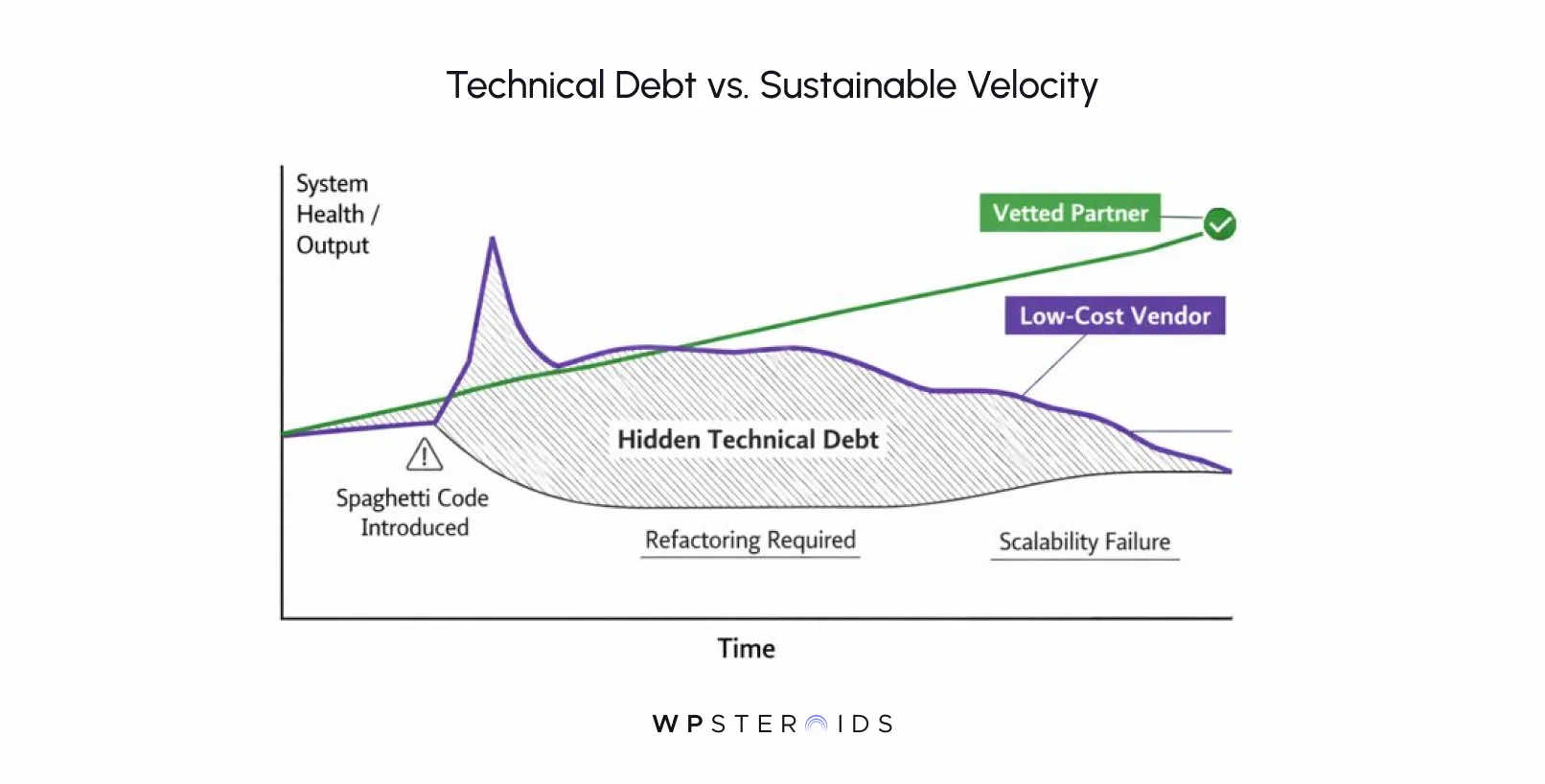
Poor outsourcing is a silent killer because the symptoms usually don't show up in the weekly status report. They show up months later, when your system crashes during a peak usage spike or when a key client churns because a "minor" bug wasn't fixed for three weeks.
To prevent outsourcing failure, you have to recognize the bleeding before the patient flatlines.
We have all seen it. The vendor delivers the feature on time. The demo looks great. Everyone claps. But under the hood, the code is a house of cards.
At first, you don't notice it. But six months down the line, when you try to scale your business or add a new module, everything breaks.
This stagnation is one of the primary drivers of outsourcing failures. The cost isn't just in remediation; it’s in the missed opportunities and the features you didn't ship while you were fixing the mess.
There is a dangerous culture in many offshore development shops: the culture of appeasement. You ask, "Can we do this by Friday?" and they say, "Yes." You ask, "Do you understand the requirements?" and they say, "Yes."
But "Yes" often translates to: "I don't want to upset you, even though I have no idea what you really want."
This lack of pushback is catastrophic. It leads to products that are built exactly to the wrong specifications. This isn't just anecdotal; it is a measurable epidemic.
Think about that. Half of the time, why outsourcing fails isn't because the developers couldn't code (though that happens); it's because they were building the wrong thing in a silo.
If your vendor lacks the confidence to challenge a vague requirement or clarify scope, you are not building a partnership; you are orchestrating a train wreck.
Finally, there is the risk that keeps most CTOs awake at night. When you hand over your codebase, you are handing over your company’s crown jewels.
If a vendor mishandles your data, the customer satisfaction level crashes to zero instantly. A breach or an IP leak dissolves trust that took years to build.
When you cut corners on vetting, you aren't just risking bad code; you are risking the legal and ethical standing of your entire organization.
Most leaders believe that once they sign the contract and set up the Slack channel, they have done their job. They rely on weekly syncs and status updates to gauge progress.
True control isn't about micromanagement; it's about structural transparency. It requires a fundamental shift in how you view the relationship—not as a service you buy, but as an extension you govern.
There is a common trap where a VP of Engineering looks at a Jira board, sees tickets moving from "To Do" to "Done," and assumes everything is fine.
This is a dashboard illusion. A ticket moving to "Done" tells you nothing about the quality of the logic, the efficiency of the database query, or the maintainability of the syntax.
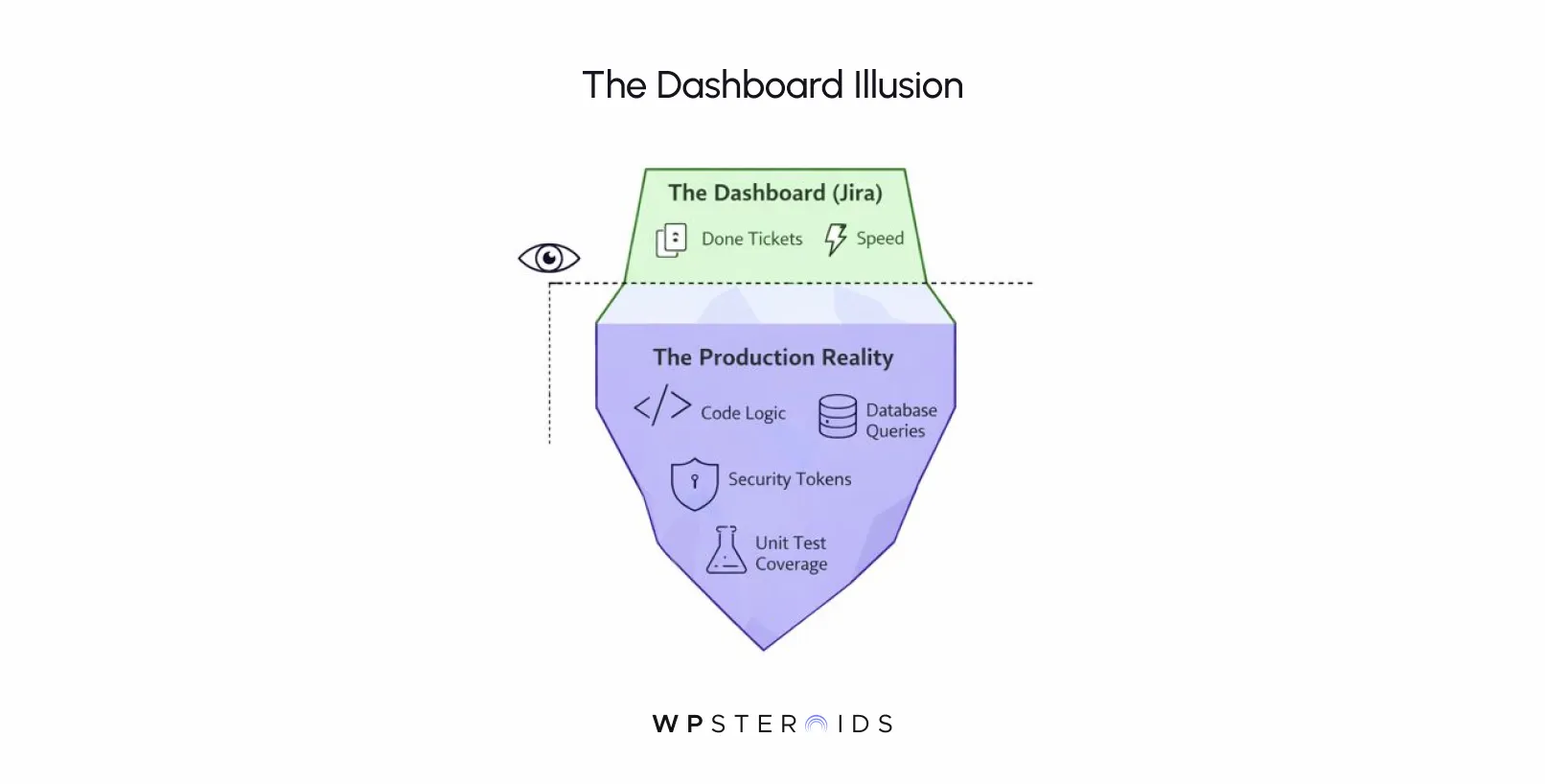
To truly integrate technology for better oversight, you need visibility into the production process, not just the reporting process.
If your outsourcing strategy relies on a weekly PowerPoint slide deck to tell you the health of the project, you are flying blind. You need to stop watching the scoreboard and start watching the game tape.
Here is where we diverge from the standard advice you will read on most vendor blogs. Competitors often sell the idea of "Total Project Management," where they take the requirements and come back three months later with a product.
They call it "turnkey." I call it a trap.
Fixed-price, black-box models often incentivize vendors to cut corners to protect their margins. Worse, they create "vendor lock-in," where you are terrified to fire them because they hold the keys to the castle.
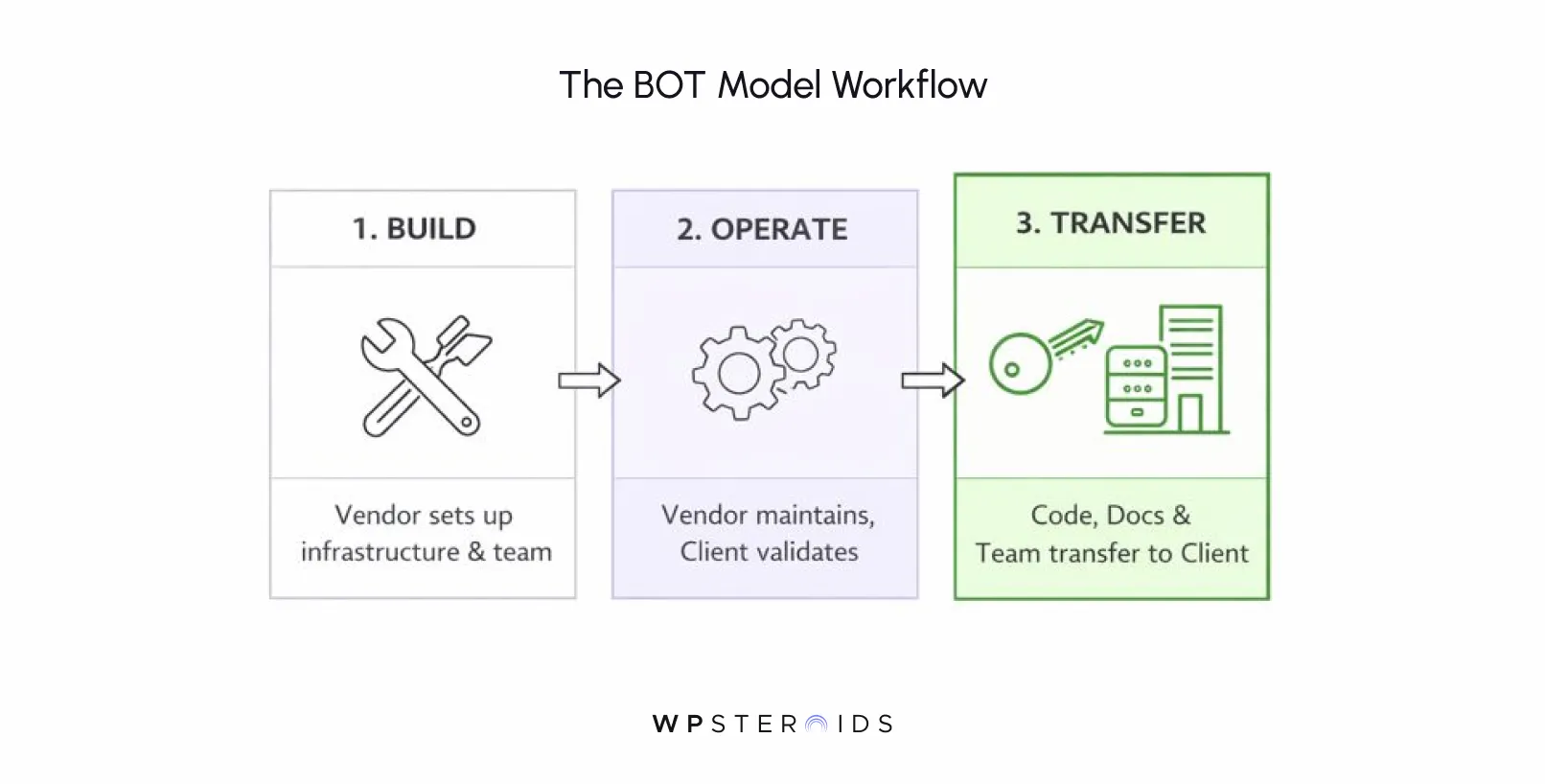
In this model, the vendor builds the team and the product, operates it for a set period, and then legally transfers the entire operation—code, documentation, and sometimes even the engineers themselves—back to you.
This approach forces the vendor to build with the end in mind: they know you will eventually look under the hood. It ensures they address the business need for long-term maintainability rather than short-term completion.
By retaining ownership of the repo and deployment credentials, you ensure that if the relationship sours, you can revoke access without losing your business. Control is not a clause in a contract; it is administrative access to your own servers.
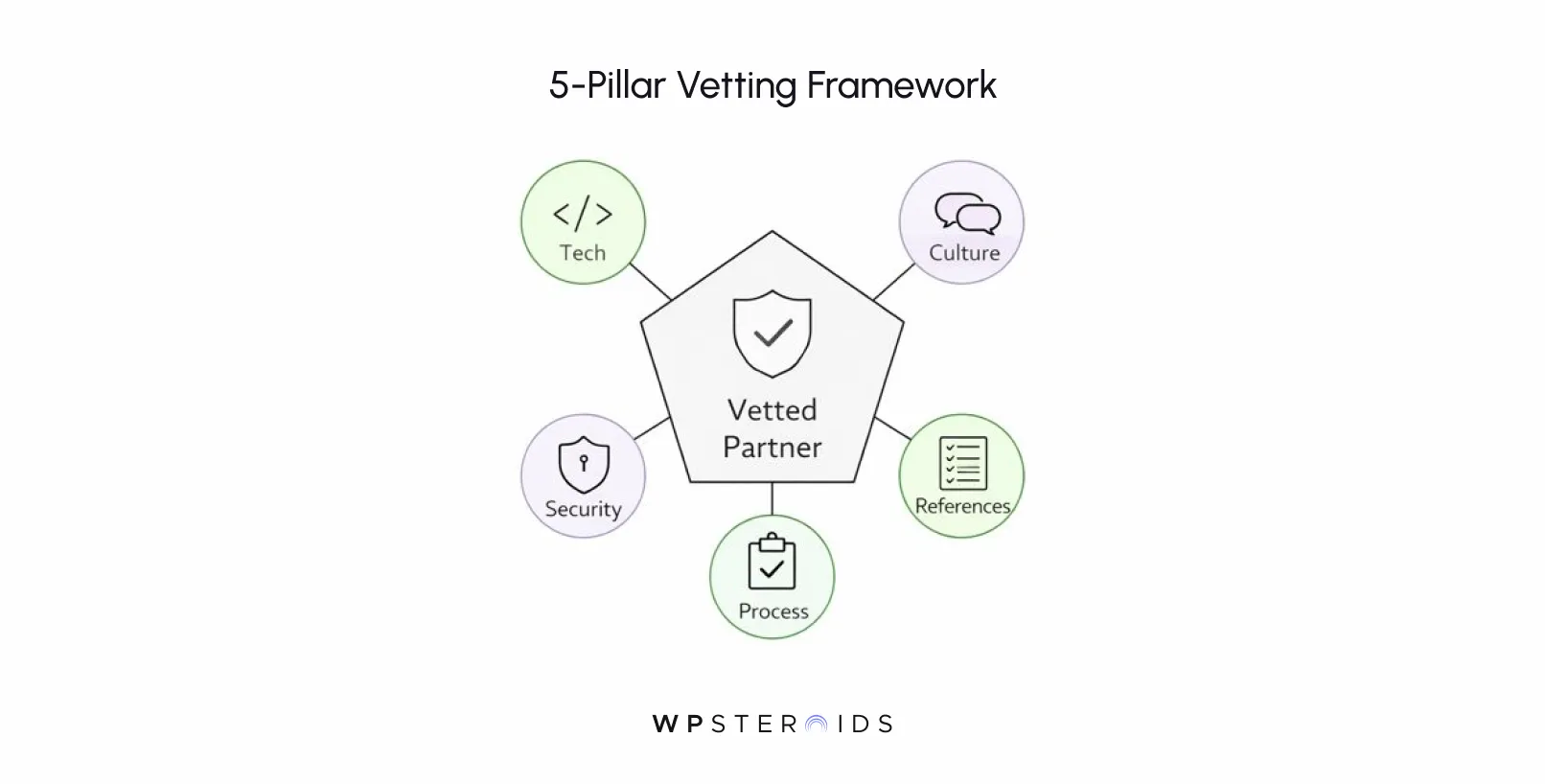
You can't fix a broken vetting process with a better interview script. You need a complete overhaul—a multi-stage protocol that treats the vendor relationship as a high-stakes audit, not a casual introduction.
This protocol focuses on five core pillars.
The resume is a marketing document. Certifications can be bought online. GitHub profiles can be padded with trivial contributions. None of these things tells you if a developer can actually solve your problems.
Instead, design coding challenges that mirror real-world scenarios they will face on your project. If they are building a REST API, ask them to build one from scratch, live, on camera.
If they will be optimizing database queries, give them a slow-running query and ask them to refactor it. The point isn't to trick them; it's to see how they think, how they debug, and how they handle pressure.
Make sure the challenges are judged by your senior engineers—the people who will be cleaning up the mess if the vendor fails.
Technical skills are essential, but useless if the team can't communicate clearly, challenge assumptions constructively, and integrate seamlessly with your existing culture.
Cultural fit isn't about sharing the same hobbies; it's about sharing the same values—honesty, transparency, and a commitment to quality.
Do they proactively raise concerns, or do they wait to be asked? Do they take ownership of problems, or do they point fingers?
Vetting an outsourced tech team is like hiring a pilot for your business flight: You wouldn't board a plane with an unverified stranger based on their low bid—you demand licenses, flight logs, safety records, and a simulator test run before takeoff.
Assessing this requires more than asking canned interview questions. Instead, simulate real project scenarios. Throw them into a mock standup meeting with your team.
Give them a vague user story and ask them to clarify the requirements. The goal is to see how they interact, how they collaborate, and how they handle ambiguity.
They should be able to articulate their branching strategy, their bug-tracking process, and their approach to continuous integration.
Don't just ask about their processes; ask for evidence. Ask to see their documentation, their test coverage reports, and their deployment logs.
A team that takes the process seriously will have this information readily available. If they hesitate or can't provide it, that is a major red flag.
If they are handling sensitive data, do they comply with GDPR, HIPAA, or other relevant regulations?
Failing to conduct these checks is not just negligent; it's reckless. You are entrusting them with your company’s most valuable assets and your clients’ personal information.
What specific vetting protocols do they have in place to ensure that data is protected every step of the way? If they cannot provide a clear and convincing answer, walk away.
Most companies ask for references. Smart companies call those references. But effective companies use the "Backchannel Method."
Reach out to them directly and ask for honest feedback—the good, the bad, and the ugly.
These backchannel references are far more valuable than the curated testimonials you will receive from the vendor.
They will give you an unfiltered view of the vendor's strengths and weaknesses, their communication style, and their overall reliability.
This is how you truly build a strong vendor relationship based on facts, not sales pitches. By using solutions tailored to your needs alongside a dependable service, this method can help ensure a successful partnership.
They sign 12-month retainers based on a PowerPoint deck, locking themselves into a marriage before they’ve even gone on a first date.
You need to shift your purchasing psychology. You are not "hiring help"; you are buying certainty. To do that, you must control the mechanics of how the relationship begins.
This starts with how you ask for what you need and ends with a "test drive" that exposes reality.
The number one reason an outsourcing initiative dissolves into chaos is vague scoping. If you send out an RFP (Request for Proposal) that says, "We need a modern, scalable e-commerce platform," you will get five different quotes ranging from $50,000 to $500,000, and none of them will be accurate.
Ambiguity is the enemy of accountability. A high-quality outsourcing vendor will actually appreciate a ruthless scope because it protects them, too.
Your RFP must move beyond high-level goals and drill down into specific measurable trackable expectation sets. Don't just ask for "high availability"; define the uptime requirement (e.g., 99.99%) and the penalty for missing it.
Don't just ask for "clean code"; specify the linting standards, the test coverage percentage (e.g., minimum 80%), and the documentation requirements.
If a vendor cannot give you a precise quote, it’s usually because you haven’t given them a precise scope. Force the clarity up front.
If they nod along to a vague requirement without asking clarifying questions, that is not a sign of competence; it is a sign they are planning to "figure it out later" on your dime.
Here is the single most effective strategy to protect your business: Never sign a long-term contract without a pilot.
This is where the 30-day paid pilot comes in.
This is not "free work"—expert engineers won't work for free. You pay them their standard rate for a small, non-critical, but representative project.
It could be building a microservice, refactoring a legacy module, or creating a proof-of-concept feature.
During these 30 days, you are testing for the intangibles that interviews miss:
If they fail the pilot, you have lost one month of budget on a small project—a low price to pay for avoiding a multi-year disaster. If they pass, you move into the long-term contract with data-backed confidence.
When reviewing a vendor's history, look past the logos on their homepage. Just because they did work for a Fortune 500 company doesn't mean they built the core product; they might have just built a landing page.
You want a partner who has already solved the problems you are about to face, not one who wants to use your money to learn how to solve them.
The sales process is the honeymoon phase. Everyone is on their best behavior, slides are polished, and promises are abundant.
But if you know where to look, this is also where the cracks begin to show. The way a vendor sells to you is exactly how they will work with you.
If the sales process feels chaotic, desperate, or evasive, the delivery will be ten times worse.
You need to develop a "spidey sense" for the warning signs that indicate your outsourcing strategy might fail before the ink is even dry.
Here are the three critical red flags that should make you close the laptop and walk away.
Imagine you walk into a custom home builder’s office and say, "I want a house." The builder immediately smiles and says, "That will be exactly $500,000, and it will be ready in six months."
You would run. Why? Because they haven't asked how many rooms, what kind of foundation, or where the land is. They are guessing to get your signature.
This "Impossible Promise" is a guarantee that you will face change orders, delays, and budget bloat later on.
It is the number one reason why outsourcing strategies fail hard. A professional partner will say, "I can't give you a quote yet.
Let's do a scoping workshop first." That hesitation isn't incompetence; it's integrity.
I mentioned earlier that the communication gap is a silent killer, but it starts right here in the negotiation.
You want a partner, not an order taker. If you suggest a technology stack or a feature implementation that is objectively a bad idea, and the vendor just nods and says, "Yes, we can do that," you are in trouble.
Great engineers have opinions. They care about the product. If you propose using a deprecated library or an over-complicated architecture, a good vendor will respectfully challenge you.
They will say, "We can do that, but here is why we think Option B will save you money and scale better."
If they agree to everything, it means they don't care about the outcome; they only care about the invoice. This "Yes" syndrome ensures that your outsourced IT project will be built exactly to your potentially flawed specs, without the benefit of their expertise.
When the system breaks, they will point to your email and say, "We did what you asked." That isn't a partnership; it's malicious compliance.
You aren't hiring a brand logo; you are hiring human beings. If the vendor’s staff turnover is 30% or 40%, it means the team you meet on Day 1 will be gone by Day 90.
The new developer has to ramp up, learn the codebase, and inevitably introduces bugs while they figure things out. This revolving door makes it impossible to build momentum.
How do you spot this? Go to LinkedIn. Look at the "Median Tenure" of the employees at the vendor’s company. If most developers stay for less than a year, that is a massive structural weakness.
It suggests poor management, low pay, or a toxic culture—all of which will eventually outsource cause problem scenarios for your project.
You want stability. You want a team that stays together long enough to own the code they write.
That approach never works. To extract real value and prevent the slow creep of technical debt, you must integrate the outsourced team so deeply into your operations that the line between "us" and "them" begins to blur.
You need a framework that forces alignment and quality every single day.
The most common source of friction in hybrid teams is a mismatched "Definition of Done" (DoD).
For a developer in a rush, "Done" might mean "I wrote the code, and it compiles on my machine." For you, "Done" means "It works in staging, unit tests are passed, documentation is updated, and no existing functionality is broken."
By automating the quality standard, you remove the emotional friction of "nagging" the vendor and rely on objective, system-driven metrics.
If you treat your outsourced team like a commodity, you will get commodity results. You will get code that meets the letter of the requirement but misses the spirit of the product.
You want a partner who challenges your architecture, suggests performance improvements you hadn't thought of, and flags potential roadblocks before they become expensive disasters.
This is how you achieve success beyond cost saving—by tapping into their collective brainpower, not just their keyboard speed.
Explicitly ask for this in your weekly retrospectives. Ask: "What part of our codebase is currently slowing you down?" or "If you could refactor one feature, what would it be?"
When you permit them to be consultants rather than just coders, you unlock a tier of value that most companies leave on the table.
You cannot rely on email. You need synchronous overlap. Structure the engagement so that there is at least a 2-3 hour window of "Golden Time" where both teams are online simultaneously. This is the window for standups, pair programming, and unblocking complex issues.
Use this time to cultivate a culture where the team can learn, adapt, and continually improve. Agile isn't just a buzzword; it's a mechanism for course correction.
If the communication felt clunky this sprint, fix the protocol for the next one. If the PR reviews are taking too long, adjust the workflow.
By treating the process as a product that is constantly iterated upon, you ensure that the outsourcing engagement becomes a seamless extension of your core business, rather than a clunky appendage you drag along.
We started with a hard truth: a bad tech team doesn't just annoy your engineers; it bleeds your revenue. It is the silent killer of customer happiness and the invisible anchor dragging down your growth.
But the inverse is also true. When you get this right, outsourcing ceases to be a necessary evil and becomes a massive competitive advantage.
By implementing the 5-Pillar Vetting Protocol, you are doing more than just filtering out bad code. You are building a defensive shield around your product.
You are ensuring that your outsourced team is not a liability waiting to explode, but a scalable engine of innovation.
Remember, CX is the only differentiator that matters. If your technology fails, your customer experience fails. No amount of marketing spend can fix a product that doesn't work.
By prioritizing rigorous vetting, rigorous scoping, and rigorous structural ownership, you are protecting the very lifeblood of your idea or business.
You can continue to play the "lowest hourly rate" lottery and hope you get lucky. You can continue to accept "yes" for an answer and hope they understand what you need.
Or, you can take control.
You can decide today that quality is non-negotiable. You can decide that you will no longer risk your reputation on unproven talent. The protocol is in your hands. The checklist is clear.
Don't gamble with your technical roadmap. Your product is too important to be a learning experiment for a generic vendor.
Book your discovery call today. Let’s build the vetting strategy that ensures your next hire helps you scale, rather than causing you to fail.
Outsourcing primarily reduces costs through labor arbitrage (accessing talent in regions with lower costs of living) and operational flexibility. It allows you to scale your team up or down without the heavy overhead of benefits, office space, and long-term employment contracts. However, true cost reduction comes from efficiency. A skilled partner solves problems faster; a cheap, unskilled partner creates technical debt that eventually costs 3x the original savings to fix.
Avoid the "black box" mentality. Never sign a contract where you do not own the source code repository or the cloud environment credentials from Day 1. Avoid fixed-price contracts for complex, evolving products, as they incentivize the vendor to cut corners. Finally, avoid vendors who agree to everything; a partner who doesn't push back on bad ideas is not invested in your success.
The three most common mistakes are:
Failure usually stems from an alignment gap, not a skill gap. If expectations regarding quality, communication frequency, and business logic aren't codified in the contract and reinforced in daily standups, the partner will revert to the path of least resistance.
Often, the vendor is optimizing for billable hours while you are optimizing for product value—these incentives must be aligned via performance-based SLAs.
Absolutely. When vetted correctly, an outsourced team improves client experience by increasing feature velocity and stability.
They can provide "follow-the-sun" support (working while your local team sleeps) to fix bugs overnight. This means your clients wake up to a better product, not a broken one.
Use the 5-Pillar Vetting Protocol:
Automate your standards. Do not rely on verbal agreements. Implement a CI/CD pipeline that automatically rejects code that doesn't meet test coverage or style guidelines.
Furthermore, integrate the vendor into your internal Slack/Teams environment and include them in sprint retrospectives so they receive continuous feedback.
Yes. This is known as the "hidden cost of bad quality." If a vendor introduces bugs that cause downtime or security breaches, the cost of lost revenue, client churn, and emergency remediation will far exceed the hourly rate you paid. A cheap hourly rate is often the most expensive option in the long run.