

Driving Digital Performance for a Digital Media Brand
Headless CMS scales and improves WPWhiteBoard’s content distribution, flexibility, and personalization
Aniket Ashtikar
You are three weeks away from a high-stakes launch. Your board is expecting a demo, your marketing team has already queued the announcement emails, and your biggest client is counting down the days.
Then, the silence begins. The Slack updates slow to a trickle, the Friday demo is "pushed to Monday," and suddenly, the deafening quiet from your tech partner tells you everything you need to know: the deadline is going to be missed.
In the high-stakes world of digital products, a missed milestone isn’t just a scheduling hiccup or a line item to be moved on a Gantt chart. It is a catastrophic breach of trust that can sink your professional reputation and jeopardize your business overnight.
An unreliable tech partner triggers a catastrophic failure chain, resulting in immediate financial overruns and the permanent erosion of client trust.
A single missed deadline creates a "butterfly effect" of operational burn and investor skepticism that fundamentally compromises your brand equity and long-term revenue.
In 2026, technical precision is the non-negotiable currency of successful technology innovation and market leadership.
The reality is that the wrong tech partner doesn't just deliver late code; they deliver institutional risk. When technology innovation is the engine of your growth, you cannot afford an anchor dragging down your efficiency.
Unreliability is rarely a sudden, total blackout. Instead, it’s a slow, rhythmic erosion. It’s the Monday standup where "everything is 90% done" for the third week in a row.
It’s the potential technology partner who stops answering Slack messages on Thursdays but promises a "big update" by the end of the day Friday that never arrives.
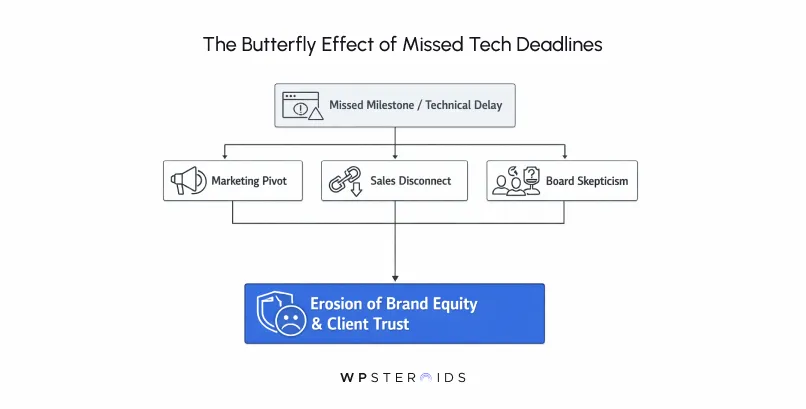
When a tech partner misses a deadline, they often treat it as an isolated technical event. They don't see the "butterfly effect" that triggers across your entire organization.
Your marketing team, which had spent months (and thousands of dollars) on a launch campaign, now has to pull back or pivot.
By the time the news reaches your board or your primary client, a "small delay" has transformed into a narrative of incompetence. In the eyes of your stakeholders, the failure isn't the partner's; it's yours.
To understand the gravity of this, consider this analogy: Choosing an unreliable tech partner is like hiring a pilot for a critical flight who shows up late with a faulty map.
One missed checkpoint—one missed deadline—doesn’t just delay your arrival at the destination. It risks crashing your entire business trajectory.
While you are stuck on the tarmac trying to fix a "technical hiccup," your competitors are soaring ahead, unscathed and seizing the market share you’ve spent years building.
Every minute you spend managing a partner who can't keep their promises is a minute you aren't spending on growth.
Once a client feels that their success is no longer your top priority—or that you’ve lost control of the tools meant to deliver it—the relationship is functionally over.
When you’re in the middle of a project crisis, it’s easy to focus on the immediate fire. You’re looking at the bug report or the empty "Done" column in Jira. But as a leader, you need to look at the "hidden math" of failure.
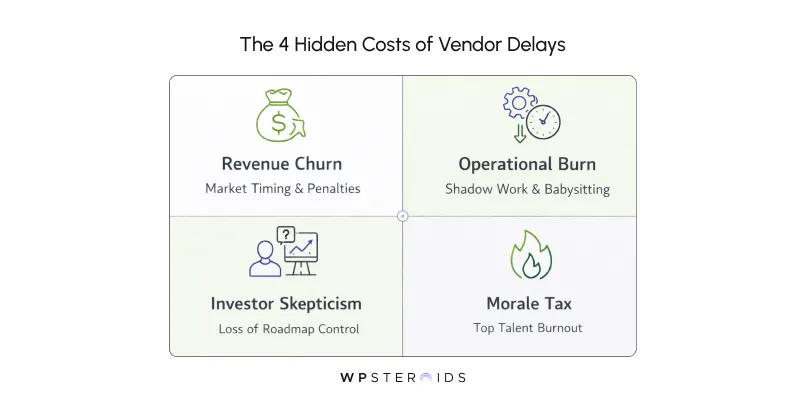
The real cost of unreliable tech partner delays isn’t just a few weeks of lost time; it is a financial and cultural hemorrhage.
To put this into perspective, we only have to look at the most recent industry benchmarks. Data reveals that the stakes have never been higher for your bottom line.
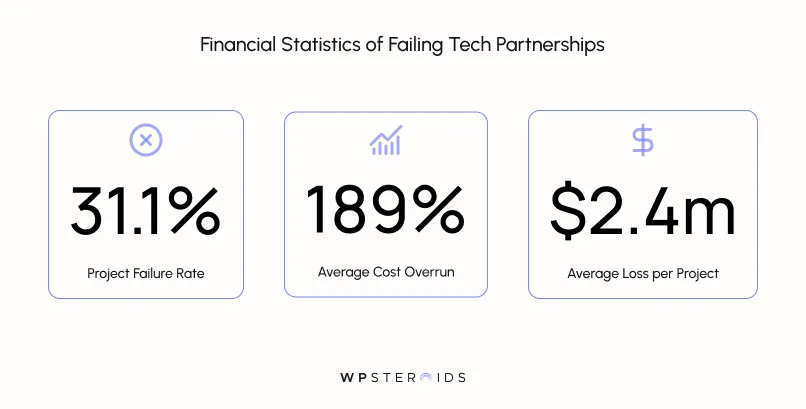
The report reveals that 31.1% of software projects with unreliable partners now completely fail, a staggering jump from the 19% failure rate seen pre-2022.
Even if the project survives, the financial toll is devastating. The average cost overruns for these delayed projects now exceed 189%.
When you do the math for a mid-sized enterprise, this equates to roughly $2.4 million lost per project due to missed deadlines and the subsequent rush to course-correct.
When a tech partner is failing to meet milestones, they aren't just late; they are actively draining your capital.
The $2.4 million figure is jarring, but it’s the way those costs manifest that truly cripples your project.
In 2026, you cannot afford to treat these delays as "part of the process." The market is too fast, and the margins for error have vanished.
Recognizing that unreliability is an existential threat to your business is the first step toward regaining control.
As a leader, your most valuable asset isn’t just your budget—it’s your intuition. However, in a complex tech partnership, intuition needs to be backed by hard telemetry.
You shouldn't find out a project is failing when the final delivery date passes; you should see it coming weeks or even months in advance.
The most dangerous red flags aren't always loud. They are the subtle shifts in momentum that signal a partner is losing their grip on your vision.
You must log every "small" slip. If two internal milestones are missed in a row without an immediate "catch-up" sprint, it is no longer a hiccup—it is a trend.
This is the moment to escalate. Waiting for a major deadline to pass before speaking up is how "manageable delays" turn into "project-killing disasters."
Watch the cadence of your standups and Slack channels. Reliable tech partnerships are built on proactive transparency. If you find yourself constantly being the one to ask for an update, the power dynamic has shifted.
Red flags in communication include:
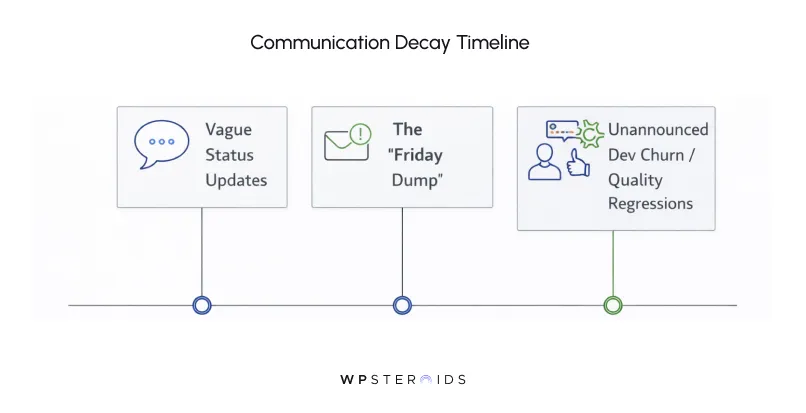
This usually happens when they are trying to "make up time" by skipping unit tests or documentation.
The Myth of the "Perfect Vetting" While most experts tell you to "vet harder" upfront, a 2025 Harvard Business Review analysis offers a more sobering reality.
They found that many unreliable partners actually perform exceptionally well during the first 30–60 days to win your trust. The real danger isn't in the honeymoon phase; it’s in the mid-contract slump.
This is why the HBR study argues that post-contract "performance audits" (bi-weekly SLA checkpoints) are the only real safeguard. It’s not enough to choose a partner once; you have to "choose" them every two weeks by auditing their output against their promises.
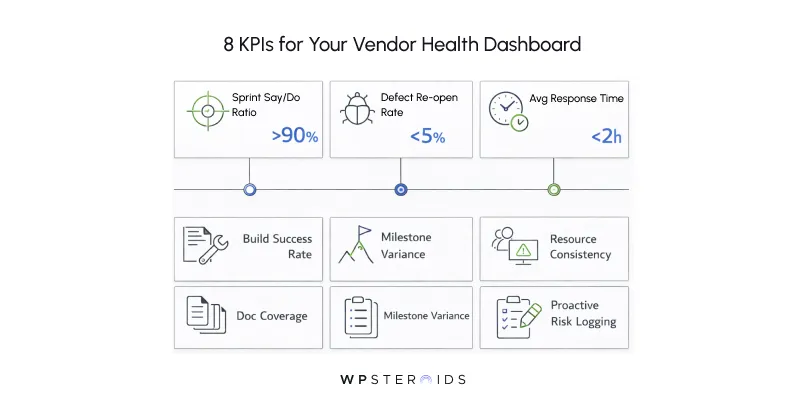
To stop being a victim of "vague updates," hold your partner to these measurable metrics. If more than three of these are trending red, the tech partner isn't just struggling—they are failing.
Prevention is not about being cynical; it is about being professional. In my decade of architecting digital solutions, I’ve learned that the most reliable tech vendors aren't just the ones with the best developers—they are the ones who welcome rigorous frameworks.
If a partner balks at accountability measures during the negotiation phase, you aren't just seeing a red flag; you are seeing your future failure.
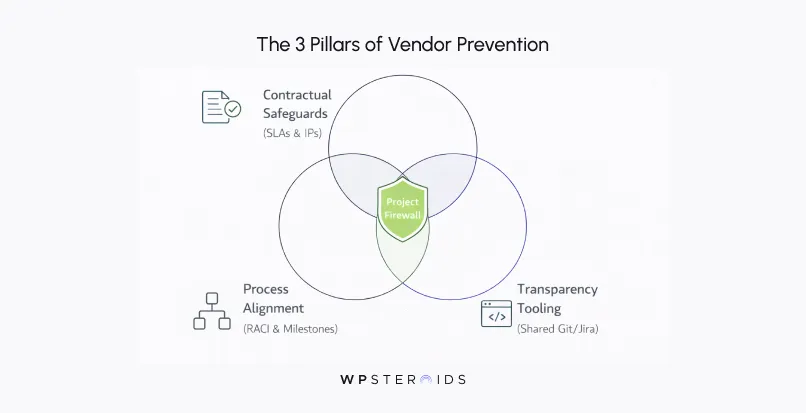
To select a tech partner who actually delivers, you need to build a "firewall" around your project using three pillars: legal leverage, process alignment, and technical redundancy.
Most contracts are written for the "sunny day" scenario. You need a contract written for a storm.
The first two weeks of a tech partnership determine the next two years. You must move past the sales pitch and get deep into the weeds about their development team.
You should never have to ask "how is it going?" You should be able to see it for yourself.
Even the best partners have "act of god" moments. Your job is to ensure those moments don't kill your business.
When the deadline has already slipped, the "prevention" ship has sailed. Now, you are in damage control mode. For a leader, this is the most critical 72 hours of the quarter.
Your goal isn't just to fix the code; it’s to stop the hemorrhaging of trust with your clients and stakeholders.
Fixes if a partner delivers late require more than technical patches—they require a masterclass in transparency.
The biggest mistake you can make is trying to hide the delay from your client while you "hope" the partner catches up. Hope is not a strategy.
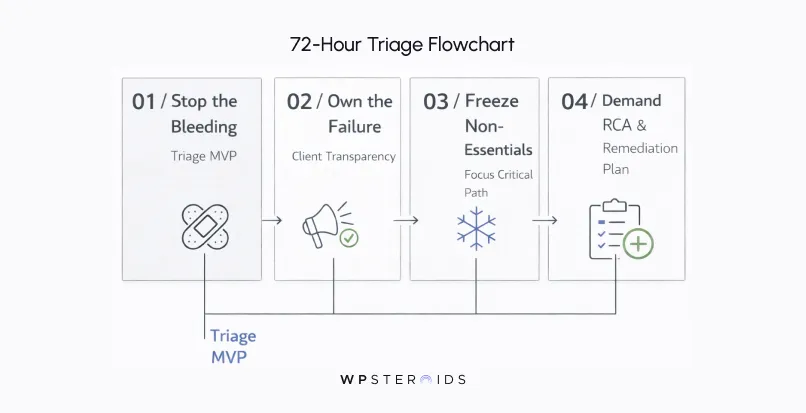
You must own the narrative before the client discovers the failure on their own.
An aligned partnerships that face a crisis will survive only if there is a clear, documented path forward. Don't accept a verbal promise that "it will be ready next week."
Demand a formal Root Cause Analysis (RCA).
You must know when to stop throwing good money after bad code. You should begin the transition process if:
To select a tech partner who can actually deliver on the recovery, you need to see them move into a "transparent" mode immediately. If they stay defensive or "black box," it is time to use your "Kill Clause."
After a disaster, the instinct is to move fast—to find anyone who can pick up the pieces and get the project moving again.
But this is exactly when you are most vulnerable to making another high-stakes mistake. If you want to avoid the $2.4 million "chaos" trap we discussed earlier, you must change how you evaluate IT companies.
Most leaders vet for talent, but the elite vet for reliability. Talent builds the feature; reliability ensures the feature survives the market.
Choosing the right tech partner requires moving beyond the "portfolio pitch" and looking deep into the operational DNA of your potential partner.
When you are interviewing a diligent technology partner, you aren't just looking for a "yes" to your requirements.
You are looking for a partner who has built-in redundancies for their own failures. Use the comparison table below to grade your candidates.
If they fall into the "Red Flag" column for more than two attributes, walk away—no matter how impressive their demo looks.
| Attribute | The "Red Flag" Partner | The Right Tech Partner |
|---|---|---|
| Proof of Stability | Shares only "sunny day" case studies with vague metrics. | Provides a "Post-Mortem" example of a project that went off-track and how they fixed it. |
| Team Structure | "Body shopping" approach; developers are rotated between multiple projects. | Dedicated pod structure with a consistent Lead Architect and PM. |
| Transparency | Status is a "Black Box"; you only see code during major milestones. | Full access to Jira/Git; proactive daily Slack updates; "open-book" development. |
| Contingency Depth | No clear plan for when the Lead Developer is unavailable. | Documented "Succession Plan" for key roles and cross-trained team members. |
| Tech Proficiency | Follows instructions blindly without questioning the architecture. | Offers "Strategic Digital Innovation"—flags potential risks in your roadmap before they happen. |
| Financial Health | Heavily reliant on your deposit to start work (cash-flow risk). | Established agency with stable runway and clear professional indemnity insurance. |
Ask to speak directly with the people who will actually be working on your tech. Many agencies lead with their "A-Team" during the sales process, but swap them for junior developers once the contract is signed.
Demand that the key personnel listed in your agreement are the ones who stay on the project.
At this stage, you realize that vendor unreliability is not just a "tech issue"—it is a fundamental threat to the viability of your enterprise.
In the high-stakes environment of 2026, a missed deadline is much more than a delay; it is the "check engine" light for your entire business.
If you ignore it, the engine will eventually seize, and the cost of the repair will far outweigh the cost of prevention.
I want you to take a breath and remember one thing: Your tech partner should be the engine of your growth, not the anchor dragging down your efficiency.
You shouldn't be losing sleep over whether a sprint will be completed; you should be focusing on how that new feature will disrupt your market.
The act of transferring technological solutions will always involve a degree of complexity, but it should never involve a lack of transparency.
When technology innovation is underway at a company like yours, you deserve a partner who respects the weight of your reputation as much as you do.
The choice is determined not just by who you hire, but by the framework of control you build around them.
Do not let a legacy of "missed deadlines" define the future of your business. You now have the playbook to stop being a victim of vendor performance and start being the architect of your own project's stability.
Take Control of Your Project Today: If you are currently staring at a dashboard bleeding red, or if you are bracing for a difficult conversation with a stakeholder, you don’t have to navigate the recovery alone.