Driving Digital Performance for a Digital Media Brand
Headless CMS scales and improves WPWhiteBoard’s content distribution, flexibility, and personalization
Mayuri Maokar
Are you one of the 80% of business leaders who believe their Content Management System is actually holding back a better customer experience? A 2024 report by Storyblok indicates that's the case for most businesses today.
If you believe that there's some tension between marketers and developers where the development team is insisting on using new tools and marketers are like, "I want to have more control", then you know this is not a technology issue. When this is the situation, selecting a headless vs a hybrid CMS has a direct effect on your team's agility and workflow.
A headless CMS separates the content backend from the coupled frontend presentation layer, delivering raw content via APIs for developers to build any experience. A hybrid CMS does the same API-first functionality but includes the same traditional, coupled frontend tools like a native page builder and in-context preview for marketing teams.
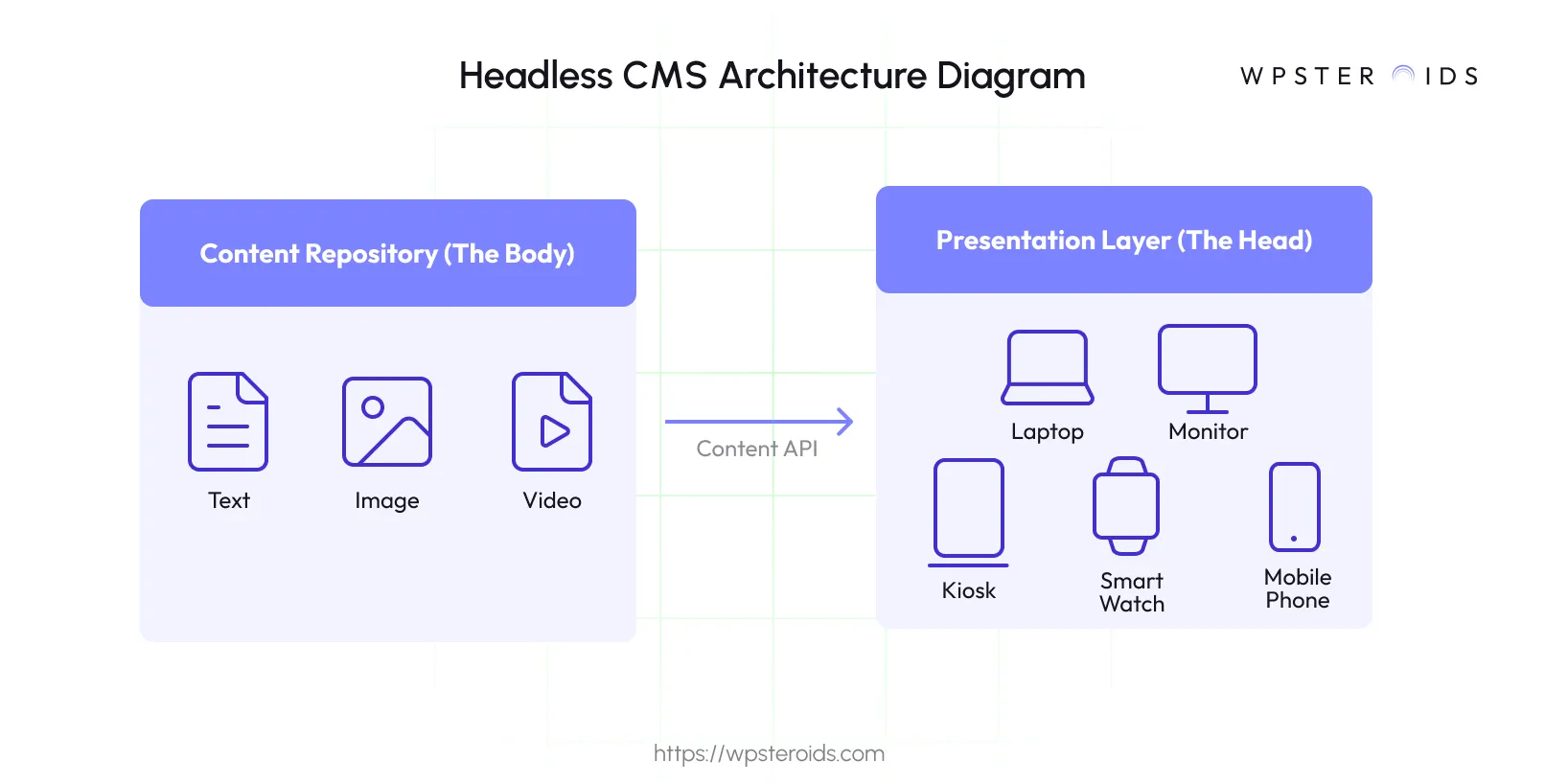
At its core, a headless CMS is a system built on a simple, powerful philosophy: content should be separate from its presentation. Imagine you have a content repository—your "body"—that stores all your text, images, and data in a raw, clean format.
The "head" is the final presentation layer, like your website, a mobile app, or a digital kiosk. A headless CMS intentionally cuts off the head, managing only the content body.
In a traditional CMS, the frontend and backend are tightly fused. You write an article in the same system that displays it on a webpage. A pure headless CMS breaks this bond. Your team creates content in a clean backend interface, but that system doesn't know—or care—what the final product will look like.
Instead, it makes that content available through a Content API (Application Programming Interface). Your developers can then "call" this API to pull the content they need and build any kind of frontend experience they want with their preferred tools and frameworks.
This api approach means the content is totally portable. The same product description can be seamlessly pulled into your website, your iOS app, and your in-store digital display without being duplicated.
This is a common point of confusion. The answer is no. While the api driven delivery is its defining feature, a headless CMS is much more than that.
It's a complete content management environment where your team can model, create, collaborate on, and organize vast libraries of content.
The API is simply the channel through which that managed content is delivered to any destination. Think of the CMS as the library and the API as the librarian who can fetch any book you request.
For teams that prioritize technical flexibility and control, the advantages of a fully headless system are significant:
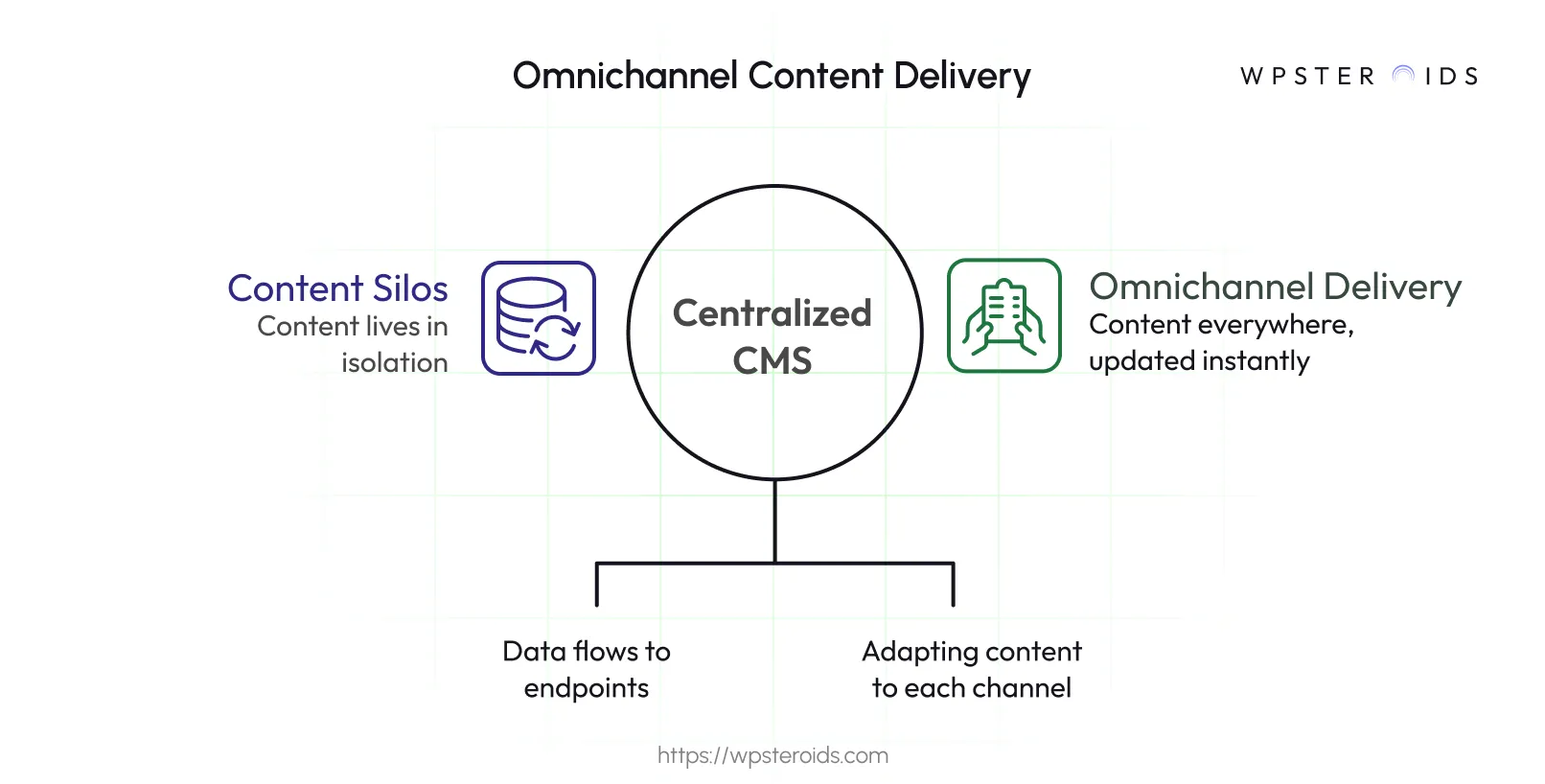
However, this developer freedom comes at a cost, and it's a cost often paid by your marketing team.
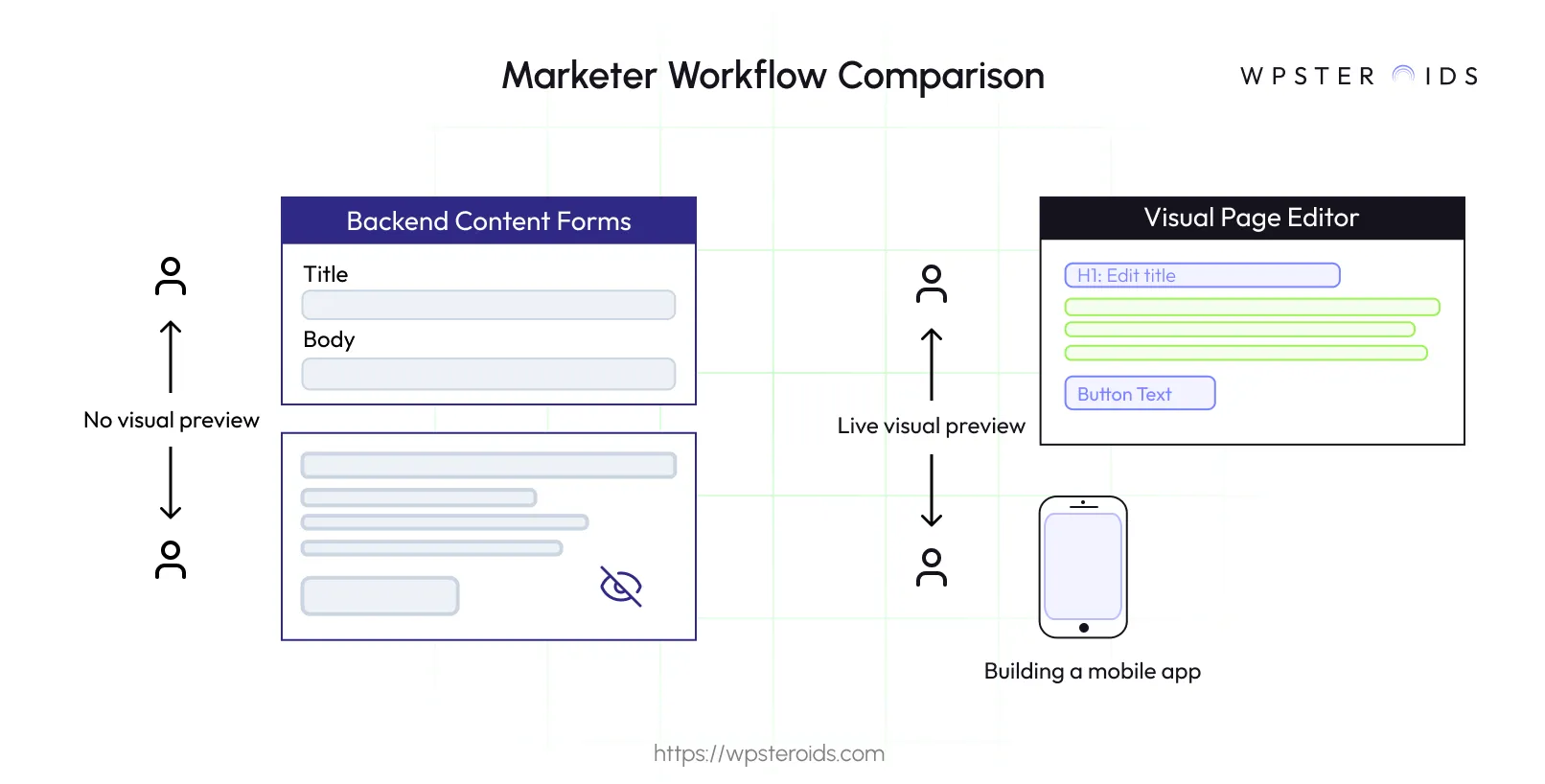
If a headless CMS is a strategic choice for developer freedom, a hybrid CMS is a strategic choice for team collaboration. It emerged as a direct answer to the marketer's "blind spot" in a pure headless world.
The core idea is simple: why can't you have the powerful, API-first architecture developers love and the intuitive, visual editing tools that marketers need to work efficiently?
A hybrid CMS is designed to give you both.
At its foundation, a hybrid headless system is built just like a headless CMS: it has a content-only repository and a robust Content API.
This means your developers can pull content and deliver it to any channel—a mobile app, a React-based frontend, an IoT device—with the same freedom they'd get from a pure headless platform.
But here's the crucial difference: a hybrid CMS also comes with a tightly integrated, out-of-the-box presentation layer. This "head" provides the marketer-friendly tools that were intentionally cut off in a headless system, like in-context page editing, content previews, and sometimes even drag-and-drop page builders.
To make this tangible, let’s use a home construction analogy:
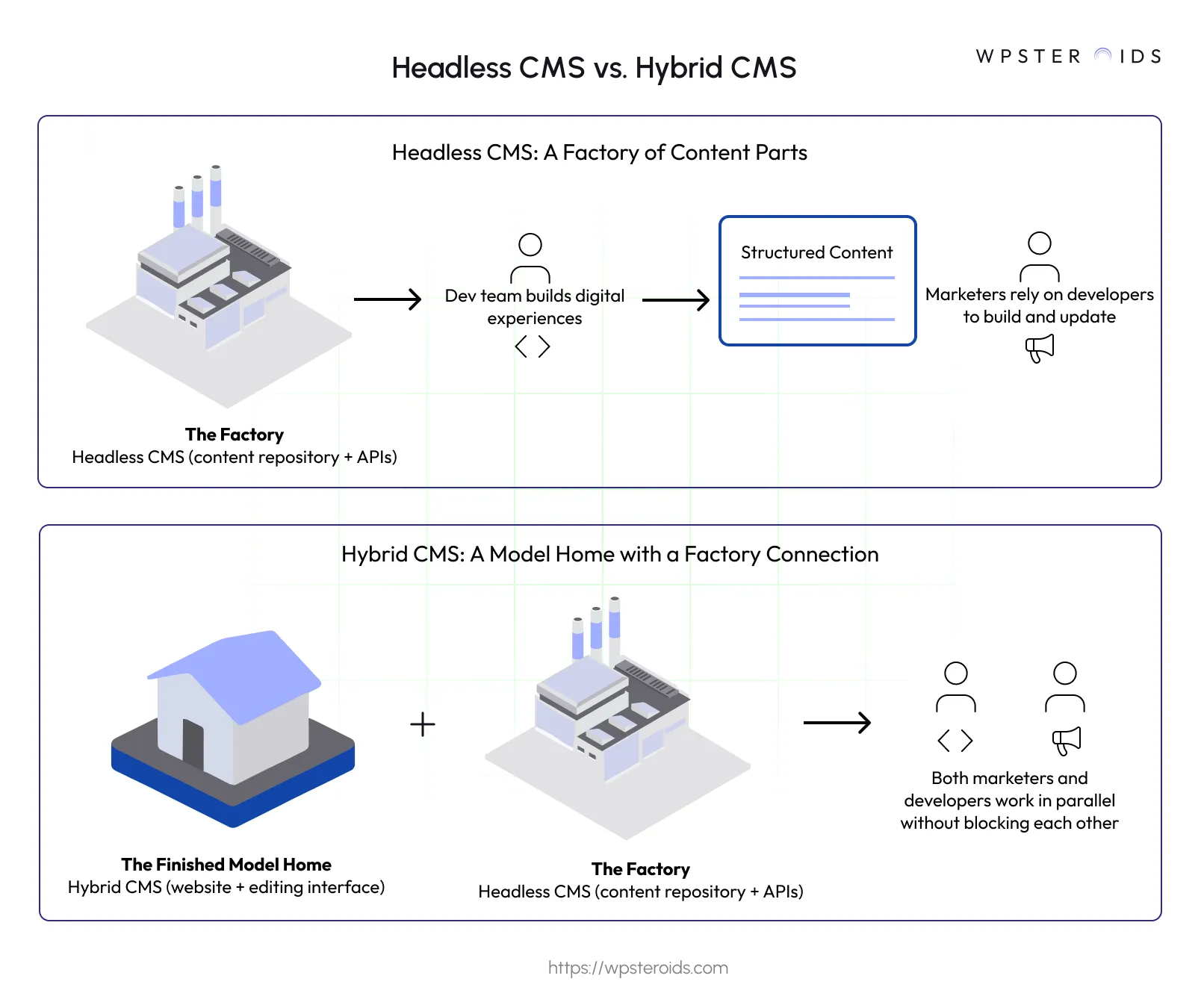
This headless hybrid approach means your teams can work in parallel. Marketers can build and launch campaigns on the main website with confidence, while developers are free to innovate on other channels using the same central source of content.
This blended approach creates a powerful win-win scenario, directly addressing the core friction between marketing and IT.
While incredibly powerful, a hybrid headless cms does come with a trade-off. The out-of-the-box presentation layer, while excellent for most websites, may not offer the absolute, 100% infinite architectural freedom that a pure headless system provides.
For an organization that needs to build its primary website with a highly niche or experimental frontend technology, the pre-built "head" might feel restrictive.
However, for the vast majority of businesses, this is a minor constraint that is far outweighed by the immense gains in workflow efficiency and team collaboration.
If the descriptions of headless and hybrid architectures feel like a solution, it’s because you’re already intimately familiar with the problem. For years, your traditional, or monolithic, CMS has been the bedrock of your digital presence.
But the ground has shifted, and that bedrock is starting to feel more like a cage.
A standard cms was designed for a simpler time on the internet. Its one and only job was to manage content and a website simultaneously.
The content and the presentation layer were two sides of the same coin, permanently fused together. This worked perfectly when your website was your only digital channel.
Today, that model is breaking. Your customers don't just visit your website. They interact with your brand on mobile apps, through voice assistants, on social media, and in personalized emails.
The challenge is that a traditional CMS locks your valuable content inside the website's code.
Need to deliver content for a new mobile app? You’ll likely have to copy and paste, creating a duplicate, disconnected version. Want to share product info with a partner's e-commerce site? It’s another manual process.
This creates a massive content delivery bottleneck. Your teams spend more time wrestling with technology and duplicating work than they do creating meaningful customer experiences.
The frustrating part of this bottleneck isn't just the clunky technology; it's the inefficient human workflow it creates. It chains your marketing and development teams together in a slow, linear process where marketers are completely dependent on developers for even minor changes to the presentation of content.
This is where many leaders make a critical mistake. They assume that simply switching to a modern CMS will solve everything. But the choice between headless and hybrid isn't the most important decision you'll make.
The real determinant of success is the quality of your underlying content strategy. As content expert Corey Vilhauer puts it, "A headless CMS won’t fix your content problems. A headless CMS with a thoughtful, flexible, and well-governed content model will".
The technology is an enabler, not the solution itself. A modern CMS forces you to stop thinking about "webpages" and start thinking about structured, reusable "content components".
Shifting to a headless or hybrid model is an opportunity to fix your broken workflows and build a content engine for the future. The real solution lies in rethinking your approach to content first, and then choosing the platform that best supports that new, more agile way of working.
Understanding the individual definitions is one thing; putting them side-by-side reveals the true trade-offs at the heart of the headless vs hybrid cms debate.
This isn't about which technology is "better" in a vacuum, but which philosophy of working is better for your team.
This is the foundational distinction from which all other differences flow.
The choice here is between a blank slate (Headless) and a powerful, pre-built foundation that is also connected to a supply of raw materials (Hybrid).
Here is where the human impact of your decision becomes crystal clear. This is the trade-off that creates the most friction inside organizations.
In a modern technology stack, both hybrid and headless architectures are built for high performance and scalability, representing a massive leap forward from a traditional CMS.
Both models scale exceptionally well because they separate the content management environment from the public-facing content delivery network.
Your CMS doesn't live in a vacuum. Its ability to connect with your broader tech stack—from analytics and marketing automation to e-commerce and CRM—is critical.
Both approaches are inherently future-proof. By decoupling your content from any single presentation layer, you ensure that as new channels and devices emerge, your valuable content can be delivered to them without needing a complete replatforming.
You understand the technology, you've seen the comparisons, and now it's time to make a decision. The choice between headless or hybrid cms isn't a technical coin toss.
It's a strategic assessment of your team, your goals, and your most critical workflows. To make the right choice, you need to look inward at your own organization.
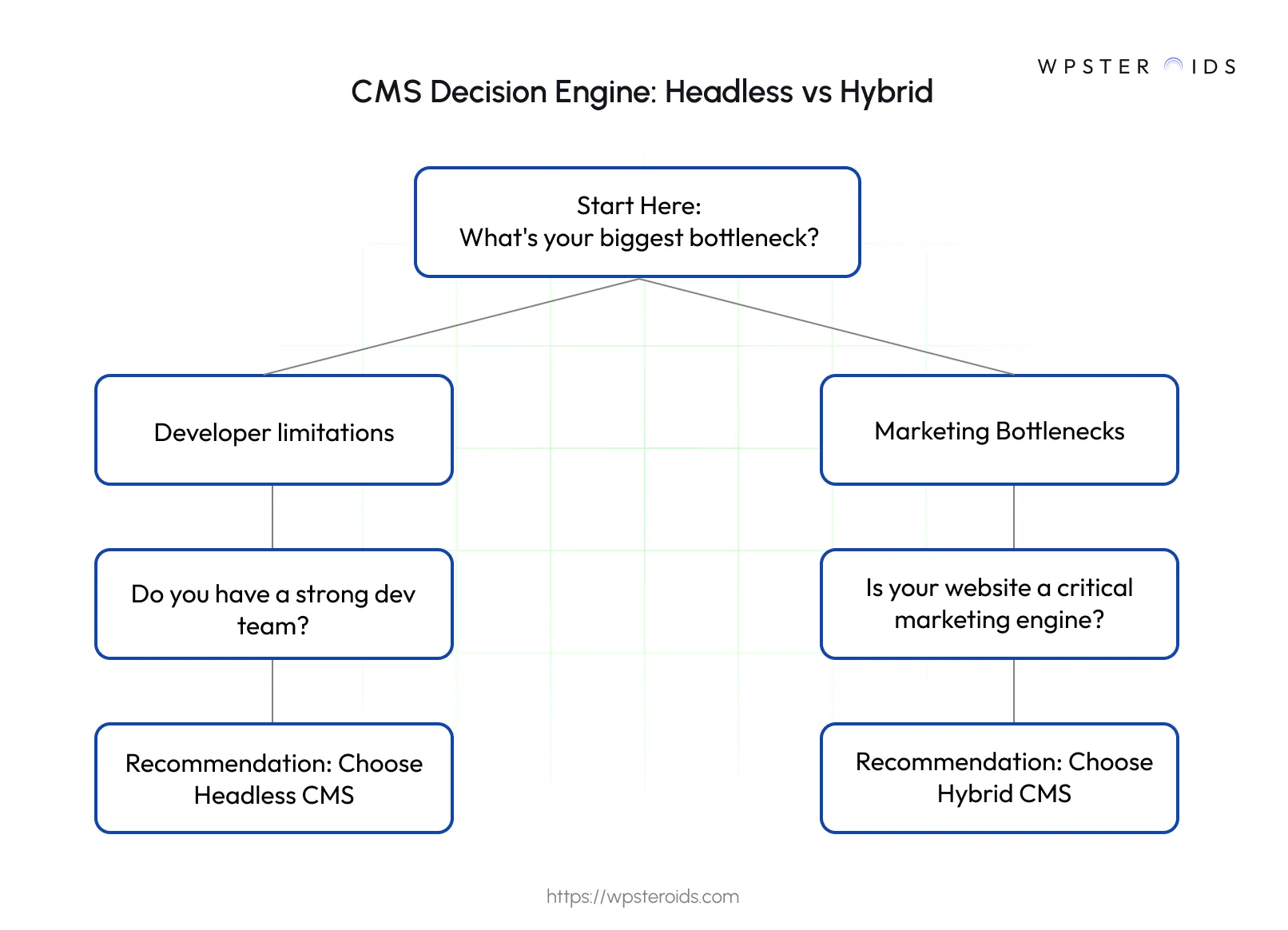
A pure headless architecture is a powerful and elegant solution when your project and team dynamics align with its developer-centric philosophy. This is the right path for you if:
A hybrid CMS is the pragmatic and powerful choice for organizations that need to balance innovation with execution and collaboration. This is the right path for you if:
Ultimately, the choice between headless and hybrid systems comes down to answering a few honest questions about your organization:
Don't frame the question as "Which technology is better?" Instead, ask: "Which operational model will make our team more successful?"
Is it a purely developer-driven model built for maximum technical flexibility, or a collaborative model that empowers both sides of the house to do their best work? The answer will lead you to the right architecture.
Choosing a new CMS is not just a software procurement; it's a decision that redefines roles, workflows, and the very rhythm of your digital operations.
The impact of this choice will ripple through your entire organization, and understanding that impact is key to making the right investment.
For your engineering team, the debate between hybrid and headless cms platforms is a conversation about their craft and their focus.
For your marketing team, this decision directly impacts their speed, creativity, and autonomy. They are the ones who feel the pain of a workflow bottleneck most acutely.
As a leader, your job is to look past the technical features and see the business case. The investment in the headless hybrid cms or its pure headless counterpart is about three things: agility, efficiency, and future-proofing.
An outdated CMS creates organizational friction and hidden costs. It burns developer hours on tasks that marketers should be able to do themselves. It locks your valuable content into a single channel, preventing you from expanding your digital footprint.
Choosing a modern CMS solves this.
A headless approach is a strategic bet on pure innovation, best suited for technology-first companies where engineering excellence is the primary driver of the customer experience.
A hybrid approach is a strategic bet on organizational velocity, designed for companies that need to empower both their marketers and developers to execute in parallel.
It’s a pragmatic choice that accelerates your time-to-market, lowers your total cost of ownership by enabling self-service, and builds a collaborative bridge between your technical and marketing teams.
This isn’t just a platform upgrade; it’s an investment in a more efficient and agile operational model for your entire business.
You’ve navigated the technical jargon and the feature comparisons. The path forward should now be much clearer.
The decision between a hybrid or headless CMS isn’t found on a spec sheet; it’s a strategic choice about your team's structure and workflow philosophy.
A headless cms platform prioritizes developer flexibility, making it the perfect engine for complex, multi-channel projects where absolute technical freedom is the primary goal.
A hybrid content management system, in contrast, offers a balanced approach, creating a powerful, collaborative ecosystem that empowers both developers and marketers to do their best work without getting in each other's way.
The core message is this: the right choice is the one that balances developer freedom with marketer enablement. Before you fall in love with any technology, analyze your team’s most painful bottlenecks, your most critical project goals, and the maturity of your content strategy.
Ready to find out which approach is the perfect fit for your organization? Book your discovery call today.
What is a hybrid CMS?
A hybrid CMS is a content management platform that combines the API-first architecture of a headless CMS with the user-friendly, visual editing tools of a traditional CMS. This dual capability means developers can use APIs to deliver content to any channel (like a mobile app or custom website), while marketing teams can use familiar tools like in-context page editing and real-time previews to manage the main company website without needing developer support.
Is a hybrid CMS just a headless CMS with extra features?
While it may seem that way, it's more of a different architectural philosophy. A pure headless CMS is intentionally minimalist, providing only a content repository and an API endpoint. A hybrid CMS is architected from the ground up to serve two distinct audiences—developers and marketers—with equal priority by providing both a powerful API and a fully integrated, out-of-the-box presentation layer.
What are the main differences in workflow between headless and hybrid CMS?
The most significant workflow difference impacts the marketing team. In a headless workflow, marketers create content in backend forms and then must wait for a developer to integrate it into the frontend before they can see how it looks. In a hybrid workflow, marketers can create, edit, and preview their work directly on the page in real-time, allowing them to launch campaigns autonomously and dramatically reducing the back-and-forth with the development team.
Are hybrid CMS platforms as flexible as headless CMS for frontend development?
For any channel other than the primary website, the flexibility is identical. Both headless and hybrid platforms provide a robust API that allows developers to use any modern frontend framework (like React, Vue, or Svelte) to build custom applications. The key difference is that a hybrid CMS also includes a powerful, pre-built (though still customizable) "head" for the main website, which accelerates development compared to building everything from scratch.
Which CMS model is better for omnichannel content distribution?
Both models are exceptionally well-suited for omnichannel content distribution because they are API-first at their core. A pure headless CMS is the ideal choice if all of your digital channels are custom-built applications. A hybrid CMS is often a more practical and efficient choice if one of your primary channels is a content-rich website that needs to be managed daily by a non-technical marketing team, while other channels are developer-led projects.
Do hybrid CMSs provide content previews?
Yes, absolutely. Providing robust, in-context content previews is one of the core reasons hybrid CMS platforms exist. They are specifically designed to solve the "marketer's blind spot" inherent in pure headless systems, ensuring content creators can see exactly what they are publishing before it goes live.
Are hybrid CMS platforms more expensive or harder to maintain?
This depends on how you measure cost. While a software license fee might be comparable, the total cost of ownership (TCO) for a hybrid CMS can often be significantly lower. This is because you save thousands of developer hours by not having to build and maintain a custom visual editor, preview system, and other foundational tools for your marketers. Empowering marketers to self-serve also reduces the ongoing maintenance burden on your engineering team.
Is a hybrid CMS better for organizations transitioning from traditional CMS?
For most organizations, yes. A hybrid CMS provides a much smoother and more intuitive transition for content and marketing teams. They get to keep the familiar visual editing and workflow functionality they are used to from a traditional CMS, which dramatically reduces training time and resistance to change. At the same time, the development team gets the modern, API-first architecture they need to build for the future.