Driving Digital Performance for a Digital Media Brand
Headless CMS scales and improves WPWhiteBoard’s content distribution, flexibility, and personalization
Ankita Deb
Feeling like you’re constantly caught in a race to the bottom on price, delivering complex projects for clients who inevitably outgrow your solutions in 18 months? You're not just imagining it.
The model that worked for growth yesterday has become a roadblock today, failing to solve the complex challenges your clients now face.
A digital platform strategy is an approach that moves beyond a single website to architect an interconnected digital ecosystem.
This unified system integrates content, commerce, and customer data to deliver consistent, personalized experiences across all touchpoints, creating a scalable engine for modern business growth.
This isn't just another article about a new trend; it’s a blueprint for your future.
More importantly, we'll define the superior value of a digital platform strategy and provide a clear roadmap for transitioning your products and services.
Learn why growing your business means moving from a project-based vendor to a long-term strategic partner who can build the resilient, high-growth digital ecosystems your clients are demanding.
For years, a well-designed website was the cornerstone of a company's digital presence. It was the digital storefront, the primary source of truth, and the main engine for growth.
But that era is over. Today, relying solely on a traditional, monolithic website is like trying to win a Grand Prix in a horse-drawn carriage.
It’s not just slow; it’s fundamentally the wrong tool for the race.
They want to launch a mobile app or a kiosk experience, but it means starting an entirely new, costly development project from scratch.
The personalized experience a user has on the website vanishes the moment they interact with the brand on social media or a partner channel.
Each data silo prevents true personalization at scale. These unsolved problems translate directly into lost opportunities, customer churn, and a ceiling on growth that a traditional website architecture simply cannot break through.
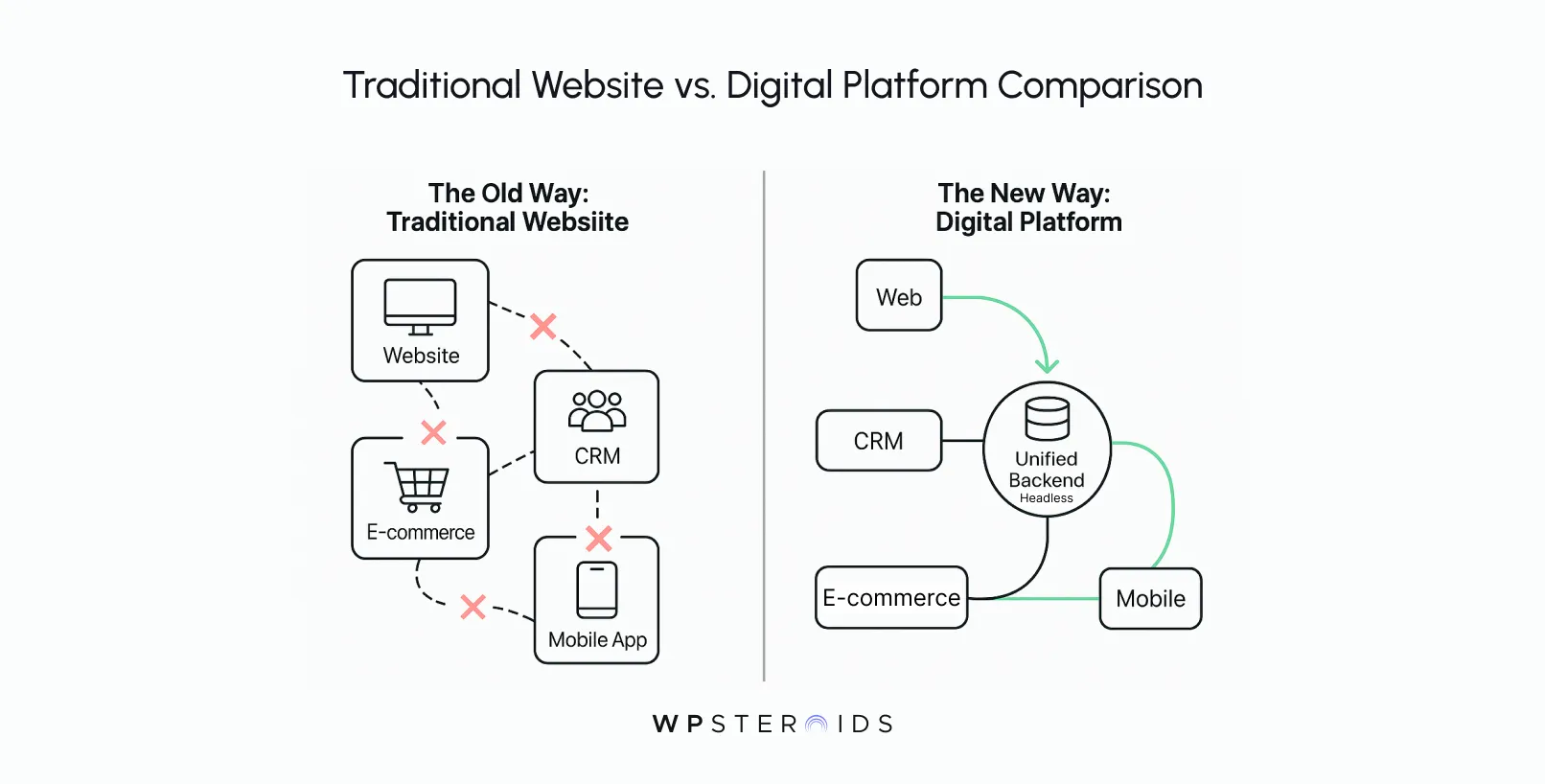
Relying on an outdated model stifles innovation and prevents the very integration needed for growing the core business.
When the deliverable is just a "website," the conversation inevitably shifts from value to price.
You're forced to compete in a race to the bottom, constantly justifying your costs against cheaper alternatives.
Differentiation becomes almost impossible. You can talk about better design, cleaner code, or faster load times, but you're still selling the same box.
In today’s competitive market is imperative to change the conversation entirely.
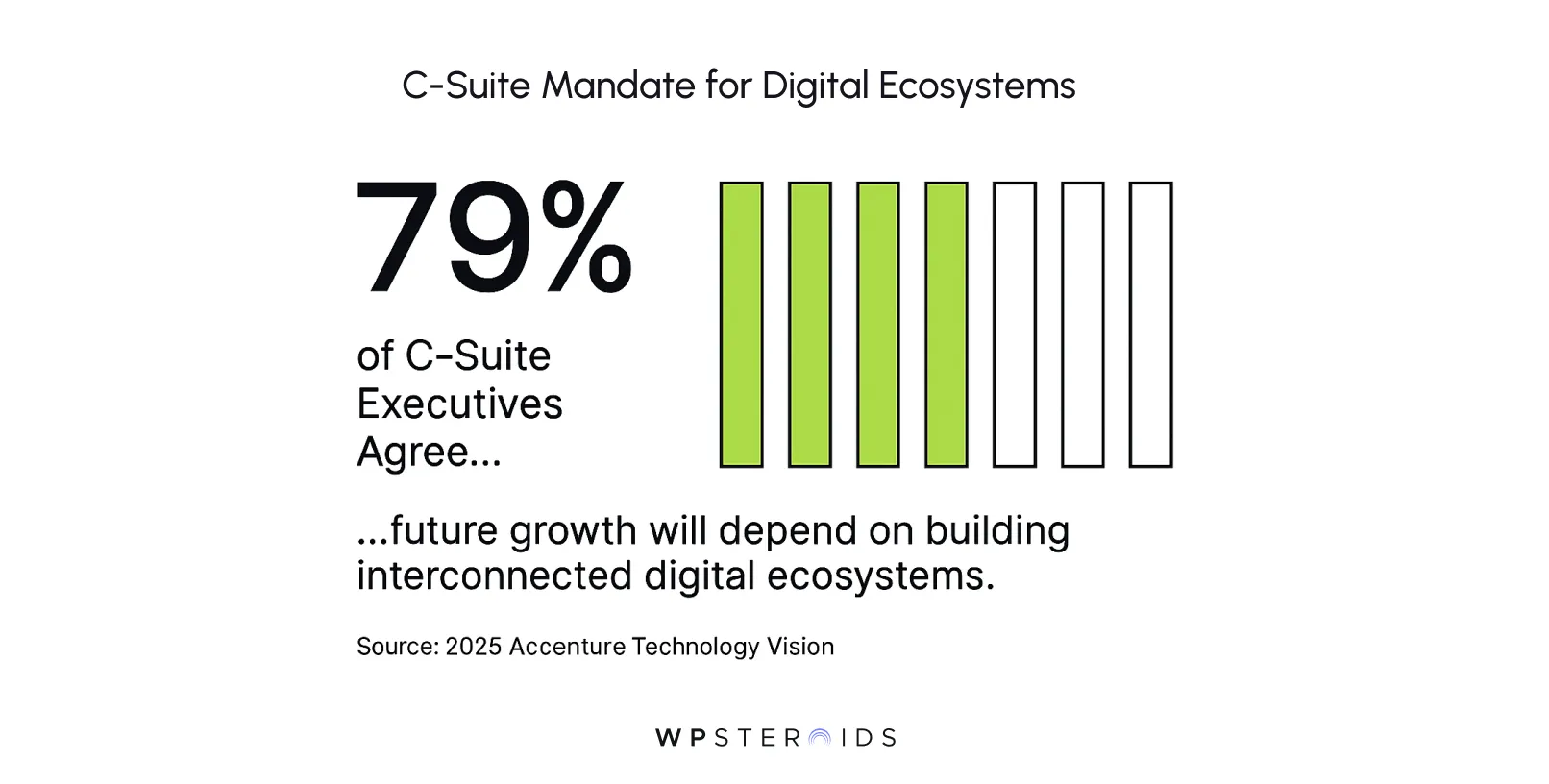
If you're wondering whether your client's current website is truly holding them back, the answer is coming directly from their leadership. The definition of digital success has fundamentally changed in the boardroom.
This isn't just a technical shift; it's a C-suite mandate.
This statistic is the tipping point. The conversation is no longer about having a great website; it’s about architecting a resilient, interconnected digital ecosystem.
Your clients' leaders are already demanding it—even if they don't have the language for it yet.
They are the ones asking, "Why can't our systems talk to each other?" and "How can we create a single view of our customer?" The answer is no longer a better website; it's a better strategy.
So, if the traditional website is a dead end for growth, what does the alternative look like? The shift is from a single, static destination to a dynamic, interconnected network.
It's about moving from a digital property to a digital ecosystem.
This isn't just a change in technology; it's a fundamental change in strategy, turning your digital presence from a cost center into the primary engine for business growth.
The concept of a "digital ecosystem" can feel abstract, so let's simplify it with an analogy.
Think of a traditional website as a single store in a mall—it looks great, has unique products, but customers must come inside to engage.
In contrast, a digital ecosystem built on a headless architecture is like a network of pop-up stores that appear wherever your customers already are—social media, mobile apps, smart devices—all sharing the same inventory and design philosophy.
You’re not tied to one store; you’re everywhere your audience needs you.
This is the critical difference. A website demands that customers come to you. A digital platform meets them where they already are.
This approach fundamentally changes the game for growth, revenue, and customer experience.
You're no longer forcing everyone down a single path; you're creating countless entry points that all lead to a unified, consistent brand experience.
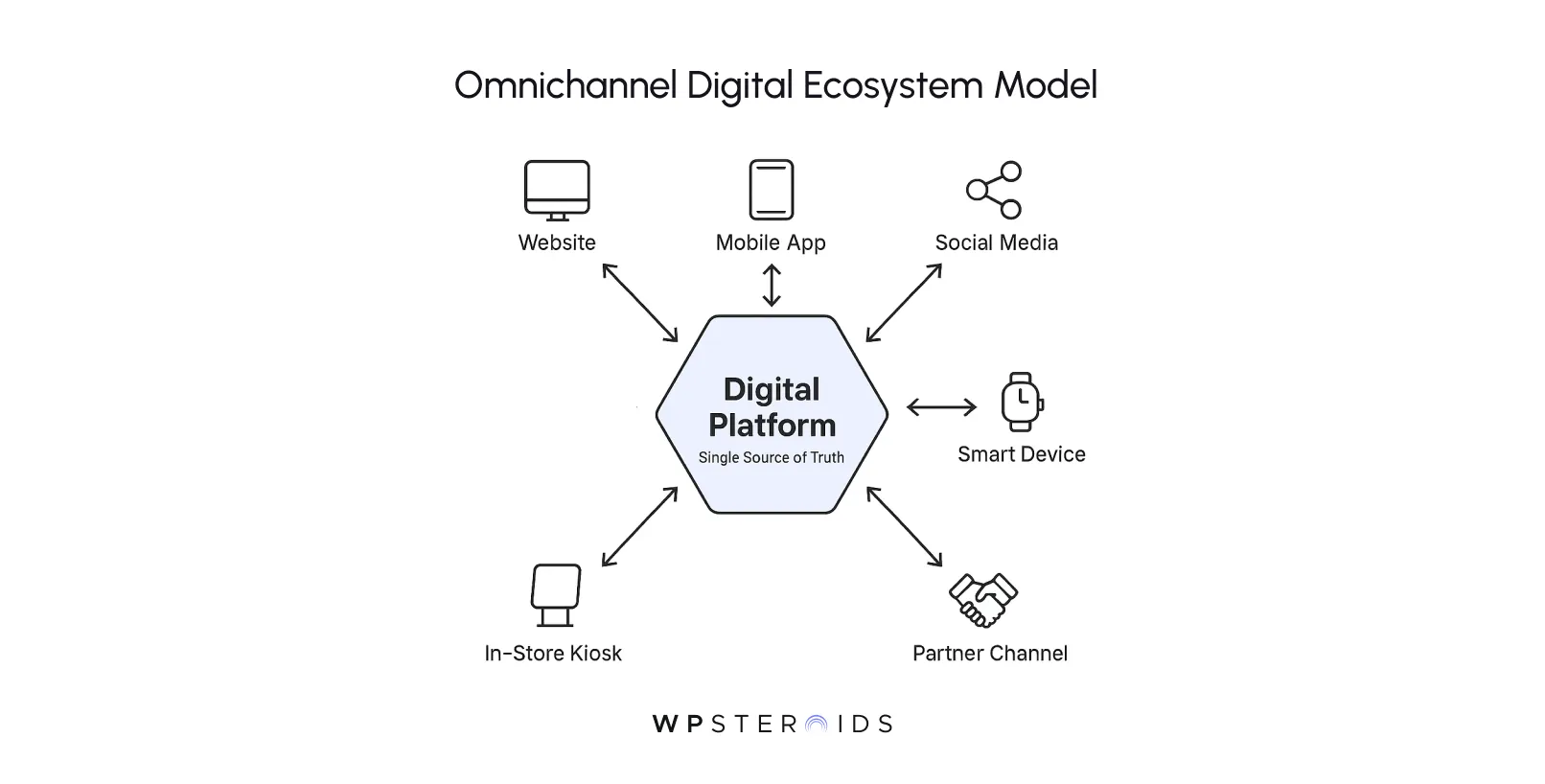
This is the foundation of building a digital ecosystem that can scale.
Because of this "network" approach, a digital platform ceases to be a simple informational brochure.
It becomes an active, multi-faceted growth engine that unifies the core functions of the business.
Ultimately, growing your business means building this integrated system. It’s the only way to effectively reach your customers everywhere online and deliver the seamless, context-aware experiences they now expect.
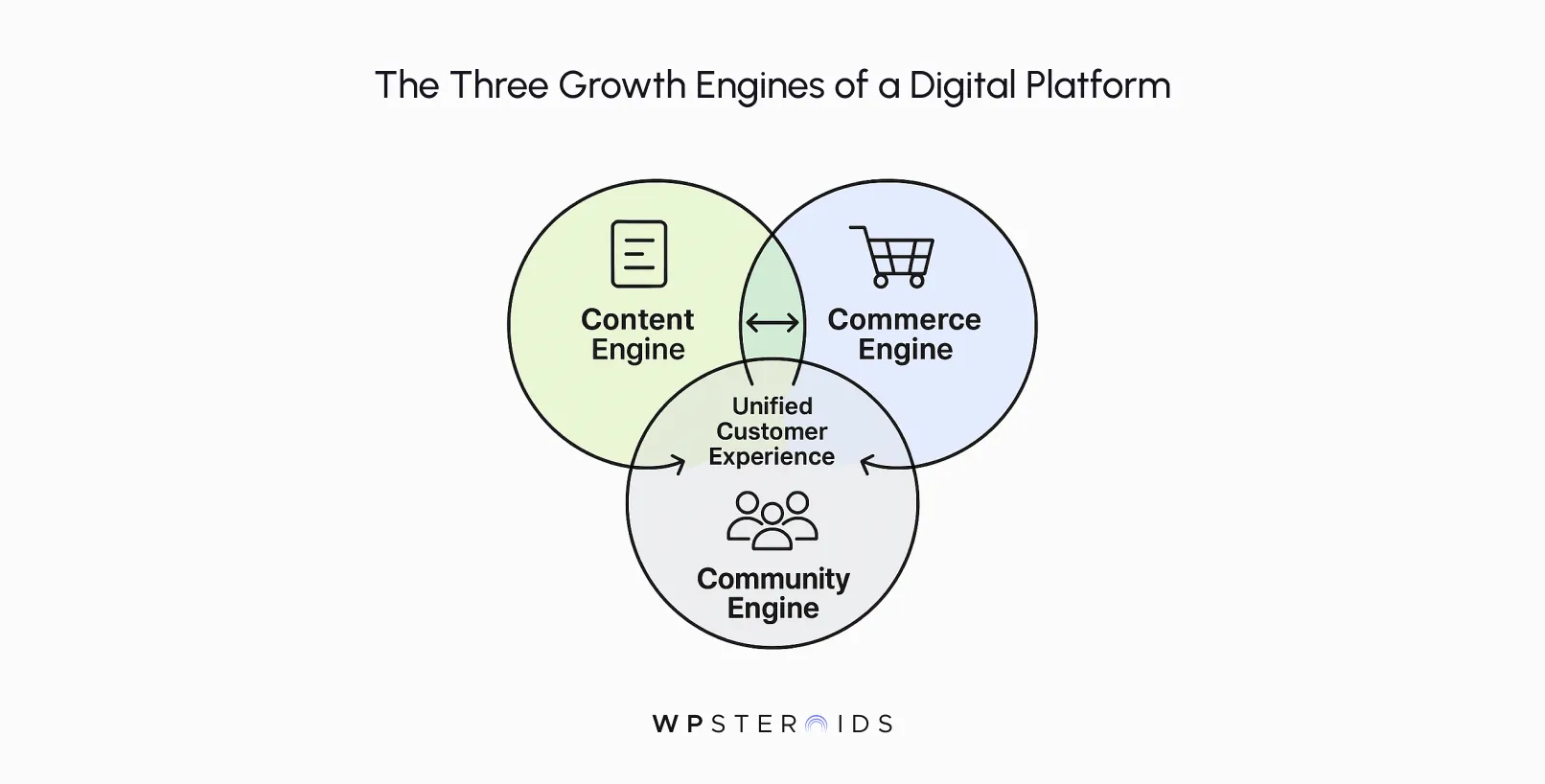
If a digital platform is the strategic destination, then headless architecture is the engine that gets you there.
This technology is the key that unlocks the flexibility, scalability, and omnichannel potential we've been discussing.
It’s what makes a true, interconnected ecosystem possible, moving you beyond the rigid constraints of a traditional website.
In the simplest terms, "headless" means splitting your digital platform into two distinct parts. In a traditional website, the "head" (the frontend, or what the user sees and interacts with) is permanently fused to the "body" (the backend, where all the content, data, and business logic live).
They are a single, monolithic system.
A headless architecture cuts that connection. The backend—your content management system (CMS), your e-commerce engine, your customer data platform—is "decoupled." It no longer dictates what the front end must look like or where it must live.
Instead, it exposes all its data and functionality through an API (Application Programming Interface).
This API-first approach gives you complete freedom. You can now build any number of frontends—a website, a mobile app, a wearable device interface, a digital sign—and they all pull content and data from the same powerful, centralized backend.
You’re no longer stuck with one predetermined "head"; you can create the perfect head for every channel and every audience.

This decoupling of frontend from backend directly addresses one of the biggest anxieties for any agency leader or CTO: building something that becomes obsolete the moment a new technology emerges.
Headless architecture is the ultimate future-proofing strategy.
How can you build something today that won't break when you triple your user base? With headless, the frontend and backend scale independently.
If a viral marketing campaign sends a flood of traffic to your website, you can scale the presentation layer without touching the critical backend systems that run the business.
This separation is crucial for maintaining high performance under pressure.
More importantly, headless allows you to adapt to the unknown. When the next disruptive device—AR glasses, smart home hubs, in-car displays—becomes mainstream, you won't need to start over.
Your core backend, your single source of truth for content and commerce, remains intact. You simply build a new frontend experience for that new channel, connecting it to the same API.
This agility turns unforeseen technological shifts from a threat into an opportunity.
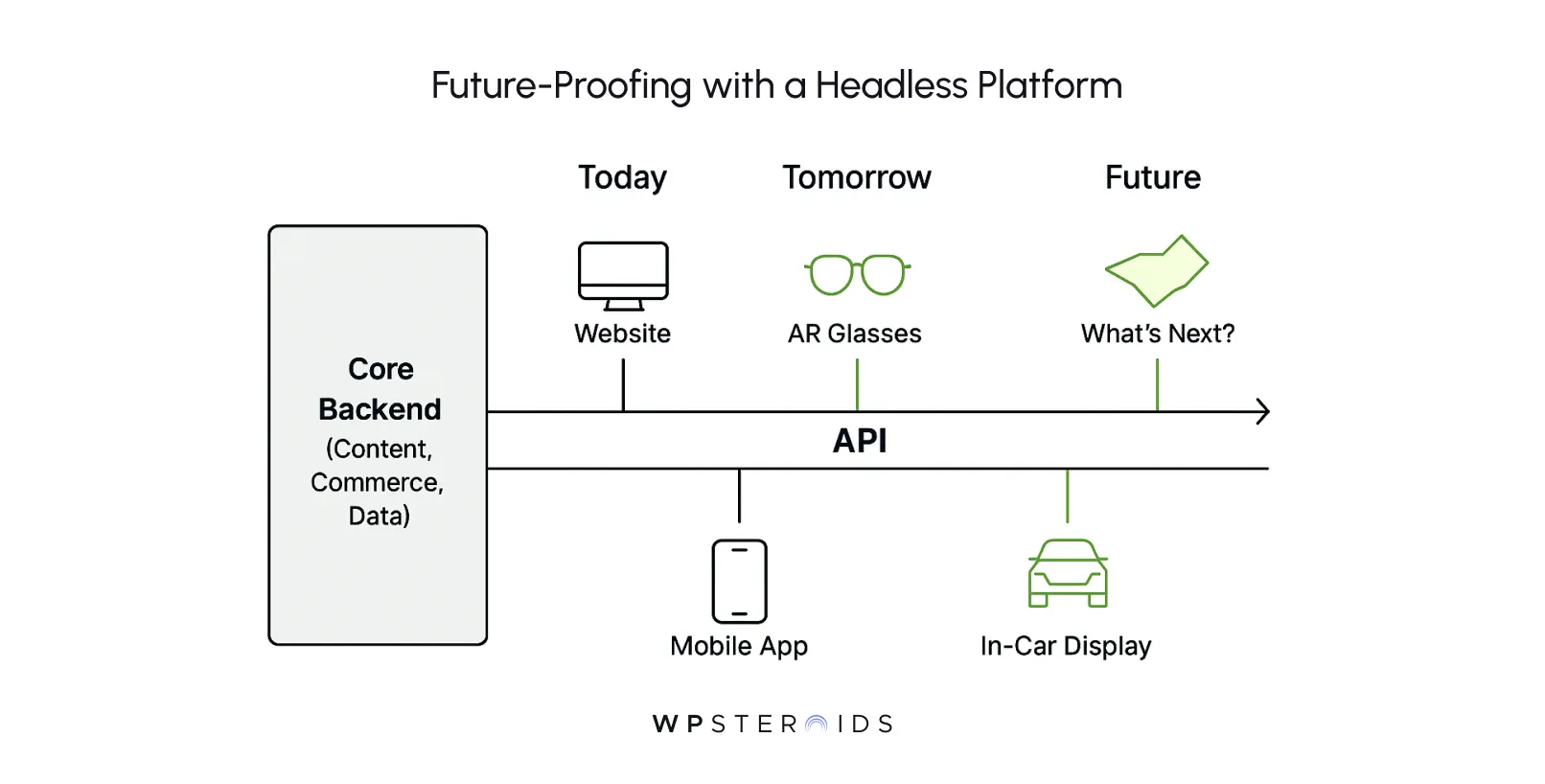
Ultimately, the goal is to create a better customer experience, and this is where headless truly shines.
How do you deliver a consistent journey across web, mobile, and beyond without your teams duplicating massive amounts of effort?
A headless platform acts as the central hub. Content is created once and distributed everywhere. This is essential if you want to improve operational efficiency.
Your marketing team no longer has to manage five different versions of the same campaign for five different channels.
They manage it in one place, and the platform ensures your messages aligned across all channels.
This allows for deep personalization at a scale that is simply impossible with a traditional website.
You can tailor experiences based on a user's entire history with your brand, not just what they did on one website during one session.
Transitioning from a familiar model to a new one requires a compelling business case. It’s not enough for a digital platform to be technologically superior; it must deliver tangible, bottom-line results that a traditional website simply cannot.
This is where you shift the conversation from a technical upgrade to a strategic investment in the future of the business.
The true power of a headless digital platform lies in its ability to seamlessly connect your content, commerce, and customer data into a single, intelligent system.
This integration is your new competitive advantage. While your competitors' websites tell a generic story, your platform tells a personal one. Imagine a customer reading a blog post on their laptop (content).
The platform recognizes them and highlights a product mentioned in the article that they previously viewed but didn't buy (commerce + data).
Later, when they open your mobile app, they receive a notification with a special offer for that exact product.
This is how you weave your brand's story into the customer's journey, making every interaction feel relevant and personal.
A headless architecture effectively showcases your brand not as a static entity, but as a responsive, intelligent partner that understands and anticipates customer needs across every touchpoint.
This shift doesn't just change your client's business; it fundamentally changes yours.
When you sell a website, you are a vendor completing a project. When the site launches, your primary role is over, and you move on to the next pitch.
But when you architect and implement a digital ecosystem, your role transforms. You become the indispensable strategic partner who built the engine for their growth.
As one leading agency founder recently noted, "We stopped pitching websites and started co-creating digital roadmaps.
Our conversations moved from talking about budgets to impacting their balance sheet."
You're no longer just selling and marketing the way you used to; you're embedding your team into the core of your client's business operations.
Ultimately, the decision to invest in a digital platform comes down to return on investment.
So how does this move truly affect the bottom line? The impact is felt across three critical areas:
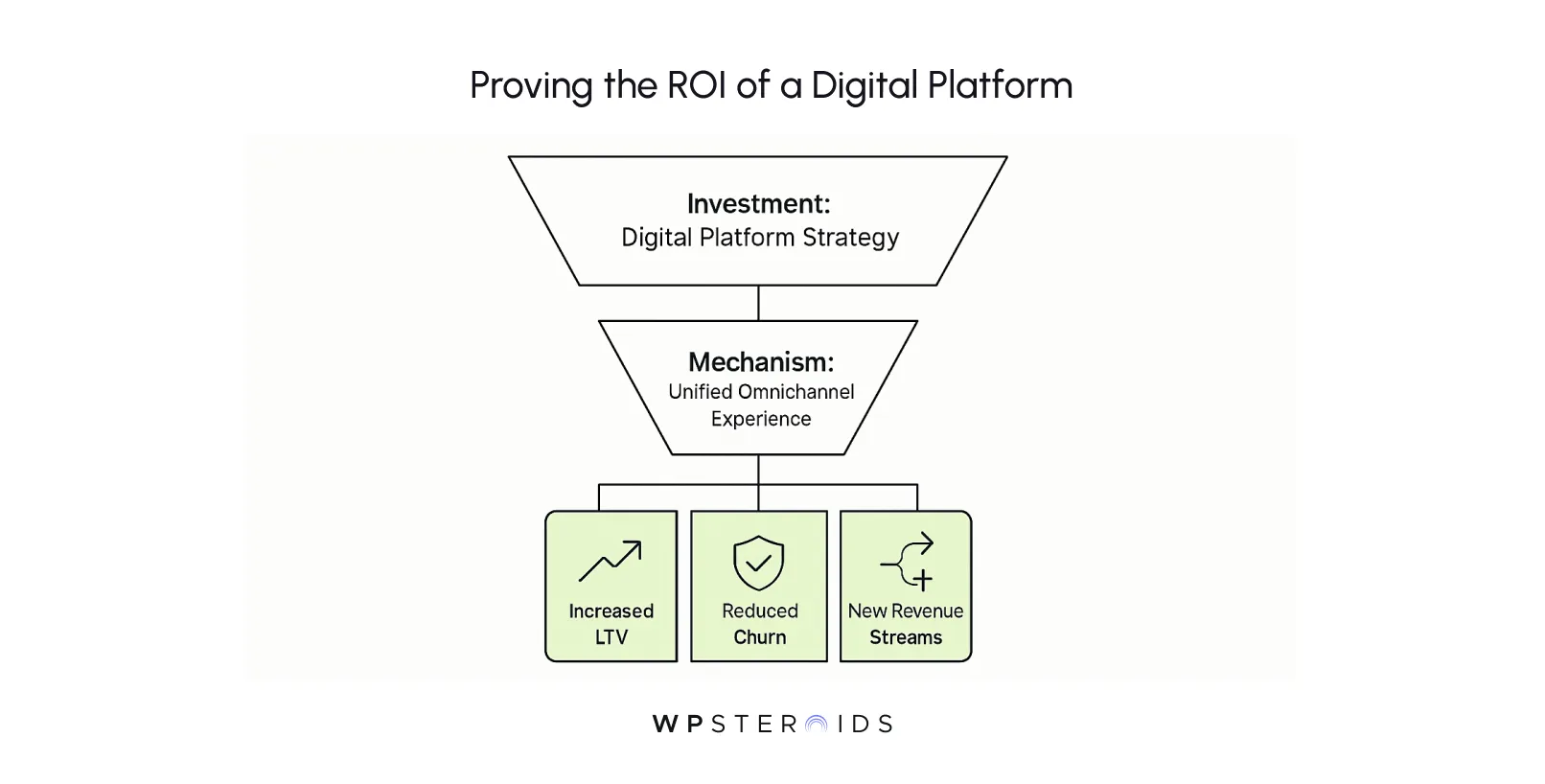
Understanding the "why" and "what" of a digital platform strategy is the first step. Making the transition happen is the next.
This isn't just a technical swap; it's a fundamental evolution of your business model, your service offerings, and your team's capabilities.
Here’s how to start making the shift from a vendor of websites to an architect of ecosystems.
What’s the very first step you should take? It isn't to research headless CMS vendors. It's to change the way you sell. You must shift the entire focus of your discovery and sales process from deliverables to business outcomes.
Stop selling "a 10-page website with a blog." Start selling "a 20% increase in customer lifetime value" or "a platform for launching into three new international markets."
The technology—the platform, the headless architecture—is the how, but it should never be the why.
This approach repositions you immediately. You’re no longer a pair of hands to build a pre-defined thing; you are a strategic partner helping them solve their most critical business challenges.
Mastering the art of communicating your point of view on business growth, rather than just technical specs, is the most crucial part of this transition.
Once you've shifted your sales approach, your service offerings must evolve to match. The old "Website Design & Development" package is obsolete.
Instead of a one-time project fee, you're now selling a foundational system for building running or scaling their entire digital operation.
Consider bundling your expertise into packages like:
These packages position you as a long-term partner, moving you away from the project-to-project treadmill and toward predictable, recurring revenue.
You can't deliver a new value proposition without the right skills on your team.
An API-first, headless world requires a different set of tools strategies and technical capabilities than a traditional, monolithic web development world.
On the technical side, your team will need expertise in:
Just as important are the strategic skills. Your team needs to develop:
Investing in this upskilling is an investment in the future profitability and relevance of your business.
Making the transition to a digital platform strategy is more than just a defensive move to stay relevant. It is a massive offensive opportunity.
For agencies and founders who see where the market is headed, this pivot is their chance to break away from the crowded field of vendors and establish themselves as the definitive leaders in the next era of digital growth.
The window of opportunity to lead this transformation is open right now, but it won't be open forever.
The vast majority of digital agencies are still competing on price to build commoditized websites.
By shifting your focus and capabilities now, you immediately differentiate your offering in a profound way. You become the one bringing a strategic, C-suite-level solution to the table while your competitors are still talking about WordPress plugins.
They see the data silos and the disjointed customer journeys. What they lack is the framework and the partner to solve it. When you walk into a pitch with a clear roadmap for building a unified digital ecosystem, you aren’t just selling a service; you are providing clarity and vision.
You become the authority, the educator, and the indispensable guide they’ve been searching for. This is how you win larger, more strategic, and more profitable accounts.
This represents a critical mindset shift that will set the true market leaders apart.
While most digital transformation frameworks emphasize building and owning more platforms, a more sophisticated strategy is emerging.
While most digital transformation frameworks emphasize building more platforms, a growing number of experts argue that success depends less on owning platforms and more on orchestrating partnerships.
In a 2024 Harvard Business Review piece, Prof. Michael Jacobides notes that the most successful digital ecosystems – like those built by Siemens and Shopify – thrive by enabling others rather than trying to dominate every layer of the value chain.
This is the new leadership model. Your role as an orchestrator is to help your clients not just build their platform but connect it intelligently to the wider digital world—integrating with partner APIs, leveraging third-party data sources, and building alliances.
It’s a move to stop selling start helping in the truest sense.
For your clients, helping a new imperative for growth means enabling their entire network, and you are the one who provides the strategic and technical glue to make it happen.
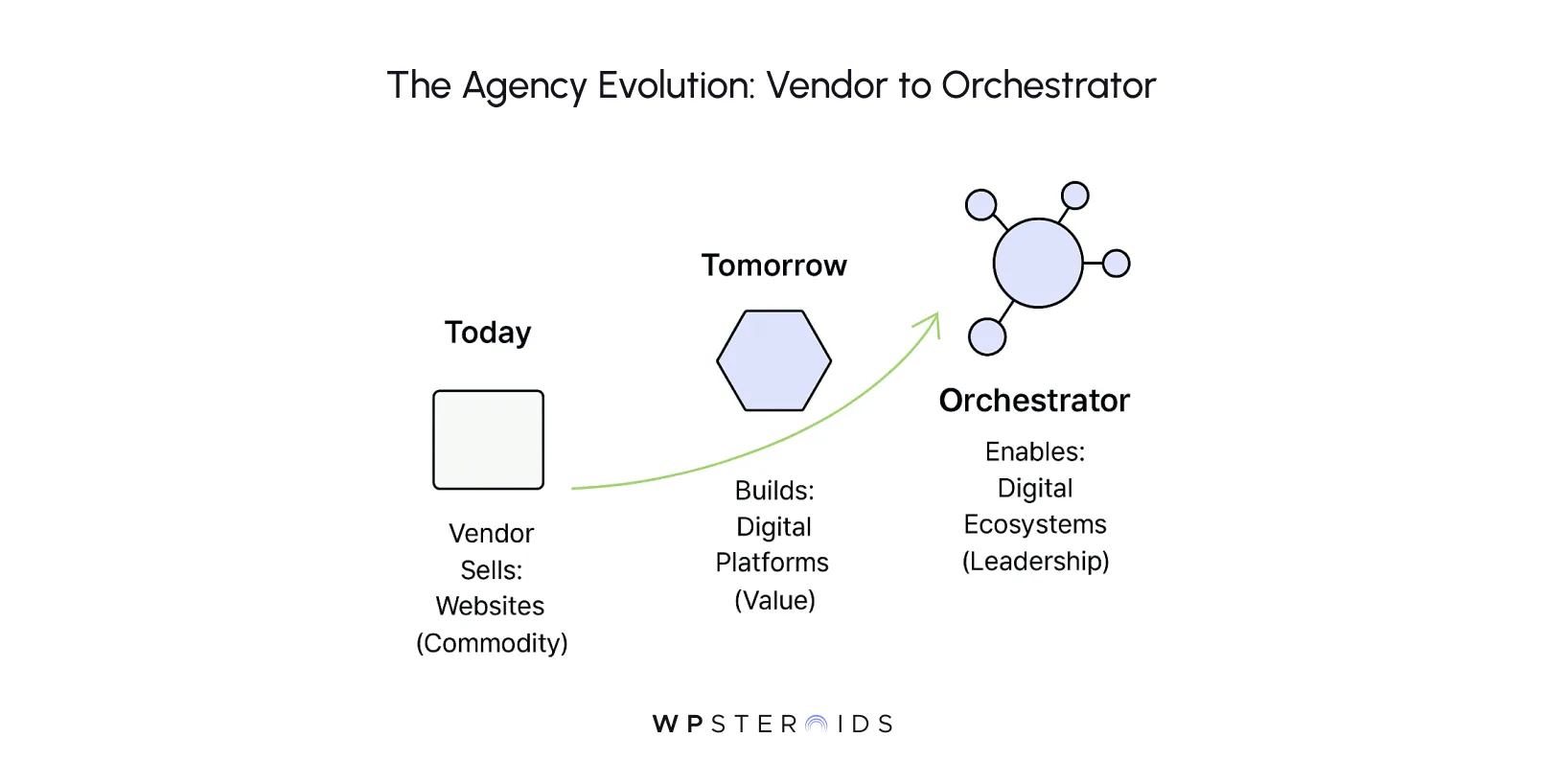
As the orchestrator, your services are not a one-time setup; they are an ongoing, essential component of your client's growth engine.
Your role becomes about managing the complexity, optimizing the data flows, and identifying new opportunities within the ecosystem.
This creates a natural, high-value recurring revenue stream that is far more stable than project-based work.
As industry forecasts show that digital ecosystems are expected to generate trillions in value over the next decade, positioning your agency as the management layer for these systems is a recipe for sustainable, long-term growth.
This model increases your agency's valuation, smooths out cash flow, and frees you from the exhausting feast-or-famine cycle of constantly chasing the next project.
The evidence is clear: the digital ground has shifted beneath our feet. The traditional website, once the cornerstone of digital presence, is now a commodity, insufficient for the complex demands of modern business growth.
Continuing to operate within this outdated model is a race to the bottom, trapping you in a cycle of tight margins and short-lived client relationships. The market has moved on.
Growth now requires a digital ecosystem that unifies content, commerce, and customer data into a single, intelligent engine.
This is the promise of a digital platform strategy, powered by the flexibility and future-proofing of headless architecture.
Embracing this shift is about more than just technology; it's a fundamental change in your business model.
It's the pivot that allows you to move from being a temporary vendor to an indispensable strategic partner, deeply embedded in your clients' long-term success.
The future of digital value creation lies not in building isolated websites, but in architecting and orchestrating fluid, API-driven digital ecosystems. This is the new imperative.
It's a move to stop selling and start helping a client build a resilient, scalable future. The way you are selling and marketing your services must evolve from delivering a product to enabling a long-term vision.
Position yourself as a strategic growth partner instead of a vendor! Stop selling websites and start building the future.
Book your discovery call today.
How does a headless approach help me scale faster without constant rebuilds?
A headless architecture decouples your frontend presentation layer (the "head") from your backend content and data management system. This means you can scale them independently. If you experience a surge in traffic, you can scale your frontend servers without touching the core backend. More importantly, when new technology like AR glasses or smart displays emerge, you only need to build a new "head" for that channel. The core engine—your content, commerce, and customer data—remains intact and is delivered via an API, eliminating the need for a complete and costly rebuild.
What’s the difference between a traditional website and a digital platform in terms of growth potential?
A traditional website is a single destination; its growth is linear and dependent on driving more traffic to that one place. A digital platform is a central hub designed to serve unlimited destinations. Its growth potential is exponential because it allows you to meet customers on any channel—web, mobile app, social media, IoT devices—with a consistent experience. It turns your digital presence from a brochure into a launchpad for new business models, revenue streams, and market expansion.
How quickly can I see ROI from moving to a headless platform?
Initial ROI can be seen quickly through improved developer velocity and faster time-to-market for new features or campaigns. Performance gains from a headless architecture often lead to immediate SEO benefits. Mid-term ROI comes from increased conversion rates driven by superior personalization and a seamless omnichannel experience. The most significant long-term ROI is realized through higher customer lifetime value (LTV), reduced churn, and the strategic agility to outmaneuver competitors.
How does a headless platform integrate with our existing tech stack?
Integration is a core strength of headless platforms. Because they are "API-first," they are specifically designed to communicate with other systems. A headless platform can act as the central orchestrator, pulling product data from your ERP, customer data from your CRM, and content from the CMS to deliver a unified experience to any frontend. It doesn't aim to replace your entire stack but to connect and unify it.
Will adopting headless increase or reduce technical debt?
While there's an initial investment to implement a headless architecture correctly, it dramatically reduces long-term technical debt. In monolithic systems, every change carries the risk of breaking something else, leading to a brittle, debt-ridden codebase. The modular nature of headless allows you to update, iterate on, or even completely replace a frontend channel without impacting the stable backend or any other channel, keeping your technology clean and agile.
How does headless architecture support omnichannel delivery?
Headless architecture is the engine of omnichannel strategy. It stores content and data in a pure, structured format, independent of any specific presentation. This content can then be delivered via an API to any endpoint that needs it—a website, a mobile app, an email campaign, a digital kiosk, or a partner's platform. This "create once, publish everywhere" model ensures absolute brand and message consistency across all touchpoints.
What’s the risk of sticking with a website-only mindset?
The risks are significant: becoming a commodity and being forced to compete on price; technological obsolescence as your monolithic site becomes unable to support new channels; creating poor customer experiences due to disconnected data and journeys; and, most critically, being outmaneuvered by more agile competitors who can innovate and adapt faster than you can.
How do ecosystems support faster product iteration and innovation?
The decoupled nature of an ecosystem allows for parallel development and rapid iteration. Your web team can launch a new feature without waiting for the mobile team, as both work from the same backend APIs. You can quickly spin up and test new experiences on a single channel as a "micro-frontend" without risking the stability of the entire system, allowing you to innovate and learn much faster.
What’s the total cost of ownership (TCO) of a digital ecosystem?
The initial investment for a digital ecosystem can be higher than for a simple website. However, the TCO over a 3-5 year period is often significantly lower. You save massive costs by avoiding the "every-two-years" full rebuild cycle. Additionally, you gain efficiencies from streamlined content workflows, improved developer productivity, and scalable, pay-for-what-you-use cloud infrastructure.
How does a digital ecosystem improve customer acquisition and retention?
For acquisition, it allows you to be present on more channels, create lightning-fast experiences that improve SEO, and syndicate content and products to partner sites. For retention, the ability to create a unified 360-degree view of the customer is a game-changer. The deeply personalized, consistent, and frictionless experiences this enables build powerful loyalty and drastically reduce churn.
How do ecosystems support omnichannel engagement and brand consistency?
By relying on a single source of truth for all content and product data. When your marketing team updates a product description or a campaign message in the headless backend, that change is instantly reflected everywhere—on the website, in the app, and on any other channel. This eliminates the risk of conflicting information and ensures customers receive a consistent, reliable brand experience no matter how they engage.
How do ecosystems streamline internal workflows and reduce silos?
They act as a unifying force internally. Content creators can use a "create once, publish everywhere" model, saving countless hours. Development teams can work more efficiently in parallel. Most importantly, by integrating systems like your CRM and CMS, you break down the data silos between marketing, sales, and service, allowing every team to work from a shared, holistic understanding of the customer.