Driving Digital Performance for a Digital Media Brand
Headless CMS scales and improves WPWhiteBoard’s content distribution, flexibility, and personalization
Nikhil Gandal
Does this sound familiar? You’re leading a talented digital team, you know exactly what your customers need, but you’re constantly hitting a wall.
Every strategic initiative—from launching a personalized pricing portal to integrating a new inventory system—gets bogged down by the rigid, all-in-one B2B commerce platform you’re trapped in.
Simple changes take months. Innovation feels impossible. You see nimbler competitors delivering a better online experience and winning deals, and you know you’re being held back by your technology. You’re not alone in this frustration.
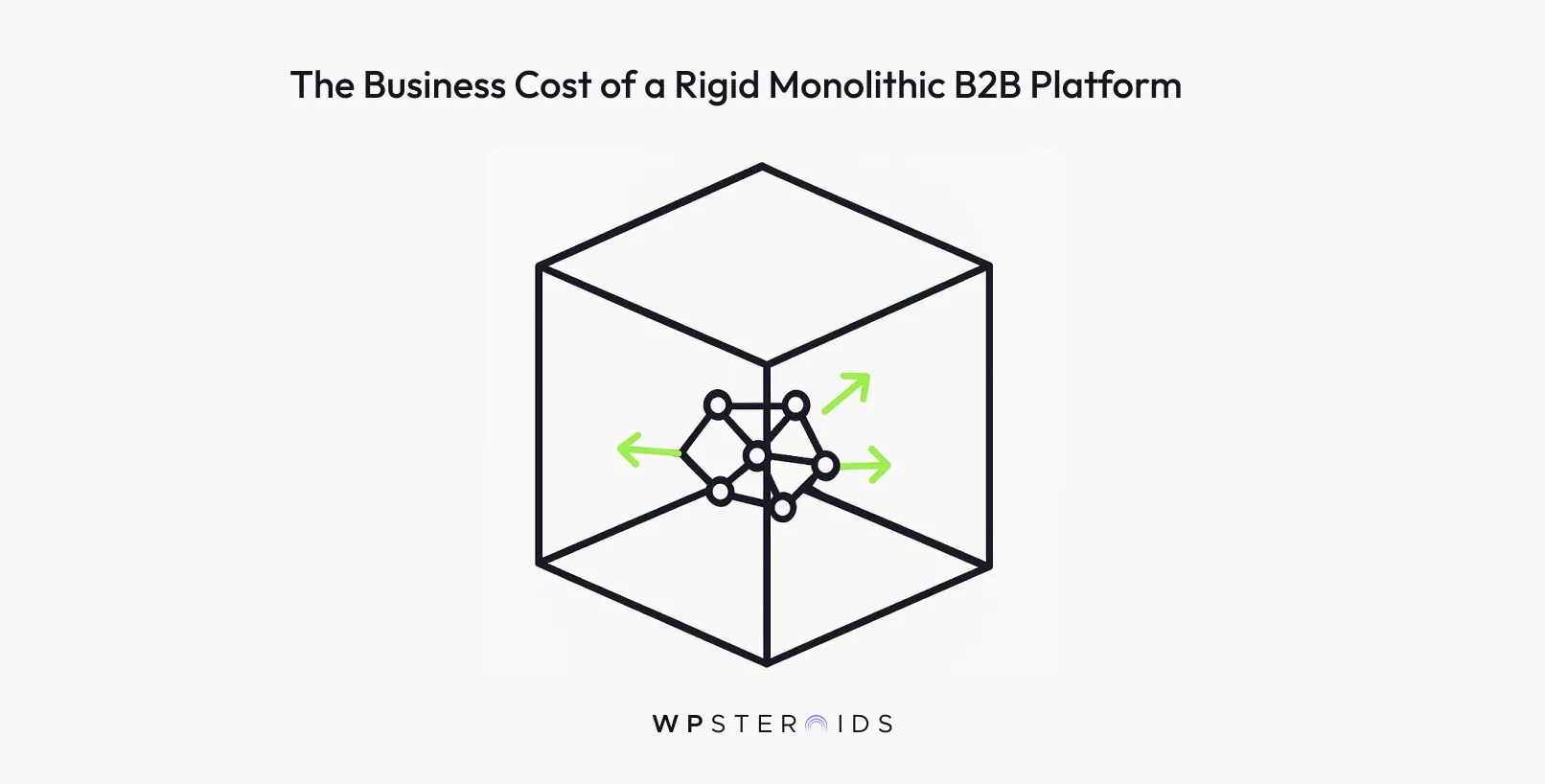
For years, B2B companies have been forced to choose between massive, high-risk replatforming projects or sticking with legacy systems that simply can’t keep up. But a new, more pragmatic path has emerged.
Composable commerce for B2B is a modern architectural approach that uses interchangeable, best-of-breed software components connected via APIs to assemble a custom eCommerce platform.
This strategy empowers enterprises to create highly flexible and scalable digital experiences tailored to complex B2B buyer needs, breaking free from the rigid limitations and slow innovation cycles of a single, all-in-one system.
For over a decade, the all-in-one, monolithic B2B commerce platform was the accepted standard. It offered a seemingly complete package—a single vendor, a unified system, and a predictable (if lengthy) implementation.
But the very thing that once made it feel safe—its tightly-coupled, rigid structure—is now its greatest liability. In today’s dynamic market, that rigidity doesn't just slow you down; it puts your entire digital strategy at risk.
The core problem with a monolithic system is that everything is interwoven. The front-end user experience, the back-end business logic, the checkout process, the product catalog—it’s all one giant, inflexible block of code.
This creates a cascade of growth-blocking problems you likely know all too well:
This is the central challenge facing B2B brands today. The changing B2B landscape requires you to be fluid, to test new business models, and to respond instantly to your customers.
A monolithic platform forces you to be static, creating a dangerous gap between what your buyers expect and what your technology can deliver.
For years, the conversation around modern commerce solutions has focused on speed and flexibility. And while those are certainly key benefits, this perspective misses the most critical value proposition for B2B leaders.
The real game-changer isn't just about moving faster; it's about building an organization that can withstand shock and seize opportunity without breaking.
Think about it. When a critical component of your monolithic platform fails or becomes outdated—whether it’s your promotions engine or your content management system—you're facing a crisis. Your only option is a massive, high-stakes overhaul.
With a composable architecture, your system is built for resilience. You can isolate and upgrade individual components without jeopardizing the entire ecosystem. If a new, superior shipping logistics provider emerges, you can swap it in via an API.
If your search functionality isn't performing, you can replace it with a best-in-class solution without touching your checkout or customer data.
This modular resilience is what allows your business to not just survive, but thrive, amidst the chaos of the modern market.
Now that we understand the risks of sticking with a rigid platform, let’s demystify the alternative. When you hear the term "composable commerce," it’s easy to get lost in the technical weeds.
But the concept is actually quite intuitive when you think about it from a business perspective. Understanding composable commerce in B2B is about seeing it not as a product, but as a new, more logical way of building your digital capabilities.
To make this tangible, let's step away from code and use an analogy grounded in the corporate world.
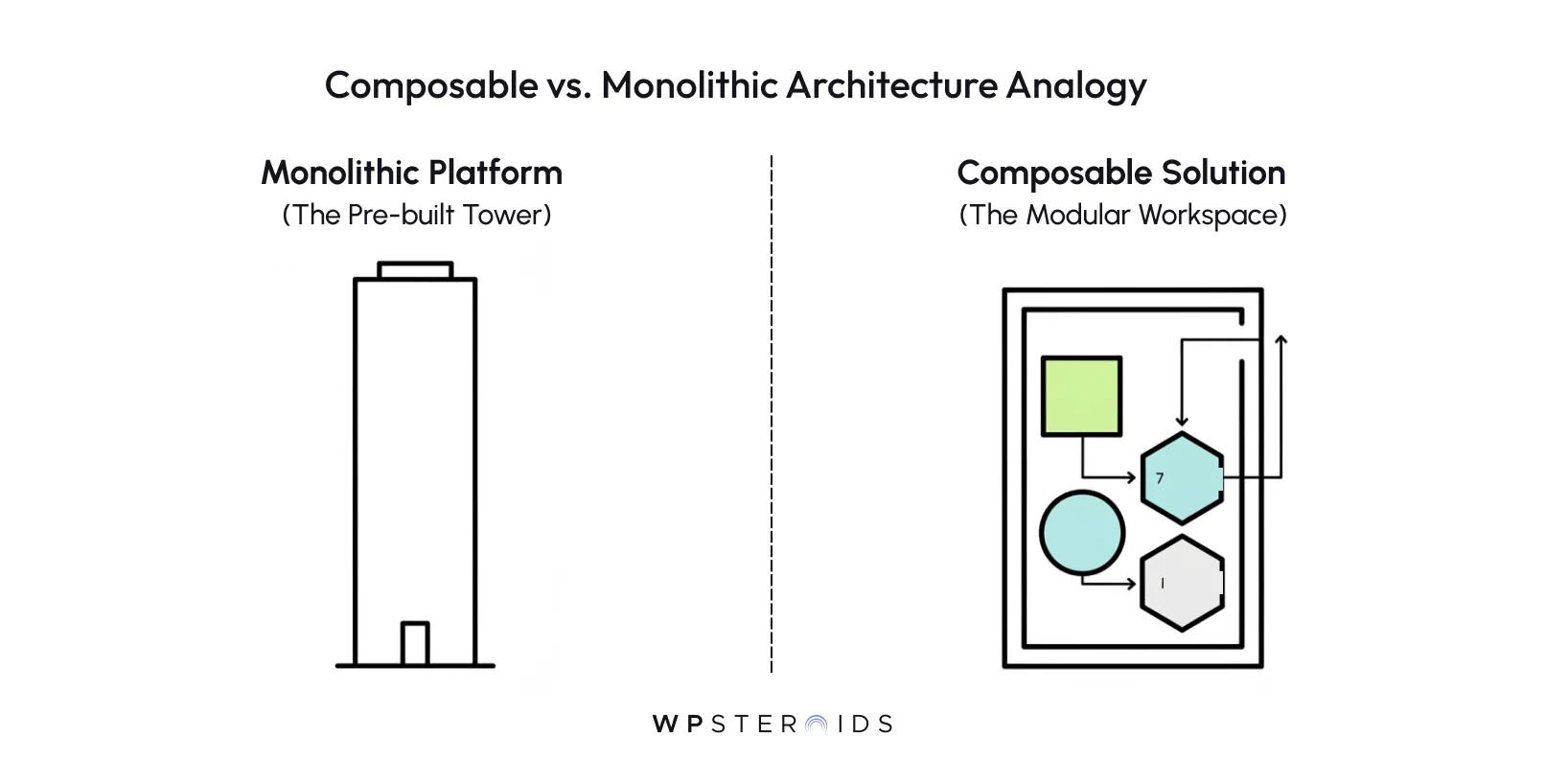
Think of your traditional, monolithic platform as a pre-built office tower. When you bought it, everything was included: the electrical, the plumbing, the conference rooms, and the offices. It was a complete package.
But now, your business has evolved. You need more collaborative spaces, a state-of-the-art data center, and a new customer-facing lobby. With the old tower, your only option is a massive, disruptive, floor-by-floor renovation that brings business to a halt. The walls and systems are fixed.
Now, imagine a composable approach as a modern, modular workspace. You still have the core building shell, but inside, you have the freedom to assemble the perfect environment.
You can bring in best-in-class, soundproofed meeting pods, integrate an advanced security system from a specialized vendor, and design a custom reception area—all without tearing down the building. If a better lighting system comes on the market next year, you can swap it in. This is flexibility and agility in the physical world.
This is exactly how a composable solution works for your digital commerce. You are no longer forced to rebuild the entire tower. Instead, you can pick the best-in-class "utilities"—like a superior search engine, a flexible pricing engine, or a specialized promotions tool—and plug them together to create the exact experience your B2B customers need.
This modular power is enabled by a set of technology principles known as MACH. You don’t need to be an engineer to grasp the business implications of this framework. MACH is what makes a composable commerce framework possible.
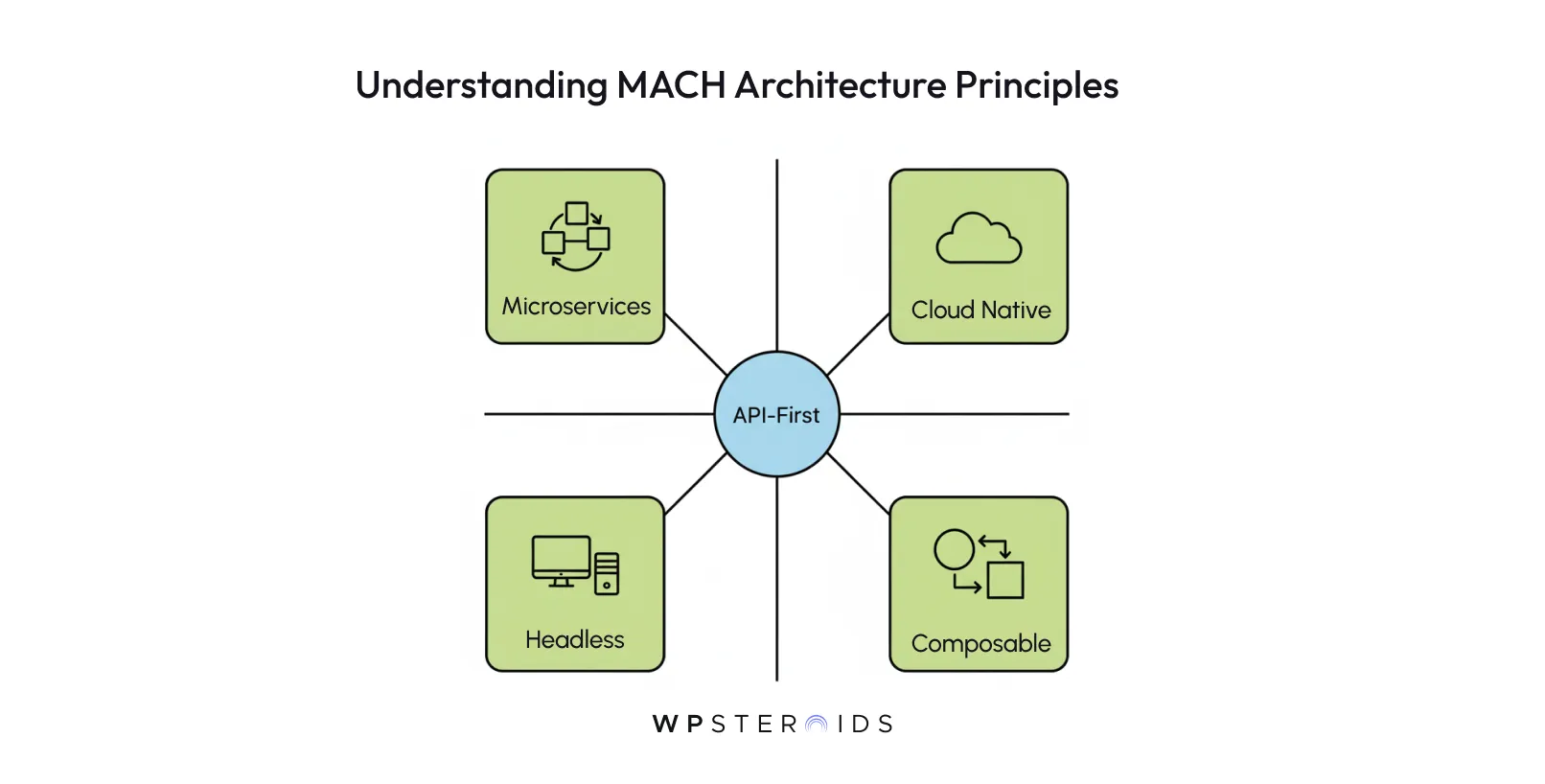
When you put it all together, the difference between the old and new ways becomes crystal clear.
Feature | Traditional Monolithic Platform | Composable Solution |
|---|---|---|
Architecture | All-in-one, tightly-coupled system from a single vendor. | Best-of-breed, independent components from various vendors. |
Flexibility | Rigid. Changes are slow, expensive, and high-risk. | Highly agile. Swap, add, or update components as needed. |
Customization | Limited to the features and roadmap the vendor provides. | Unlimited. Build the exact, unique experience your customers demand. |
Time-to-Market | Long. New features or channels can take 6-12 months. | Fast. Deploy new functionality in weeks or even days. |
Vendor Lock-in | High. Migrating away from your single vendor is a massive undertaking. | Low. You are in control, free to choose the best tool for every job. |
The shift toward composable commerce isn't just a technology trend; it's a direct response to a fundamental power shift in the B2B world. For decades, sellers held all the cards. The buying process was dictated by your sales cycle, your product catalogs, and your internal processes.
That era is over.
Today's B2B buyer is in complete control, and they have a new set of non-negotiable expectations. This is why forward-thinking leaders are recognizing that the old way of building a digital experience is no longer viable.
Think about the last significant business purchase you were involved in. Did you start by calling a sales representative? Probably not. You started with research. You read reviews, compared technical specifications, watched demos, and sought out case studies.
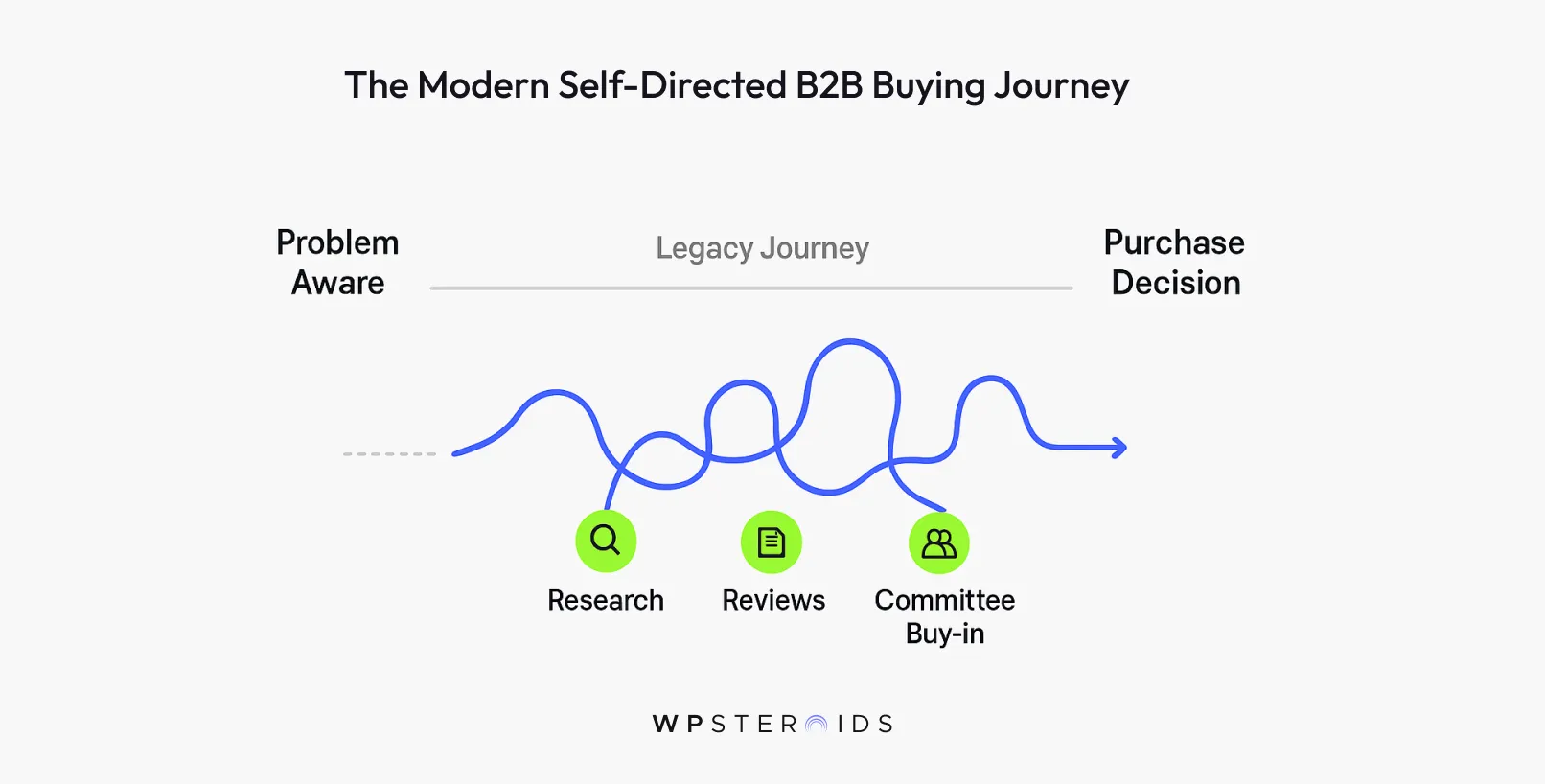
They expect to find everything they need on their own terms, at any time, on any device. They want rich content, deep technical data, and transparent pricing, all before they ever speak to a person.
Legacy platforms simply weren't built for this reality. They were designed for a straightforward, transactional process: find a part number, add it to a cart, check out. They struggle to support the consultative, content-rich, and multi-threaded journey that defines B2B commerce today.
The B2B buyers you're trying to reach are the same people who go home and use Amazon, Netflix, and Uber. They have been trained to expect a seamless, intuitive, and highly personalized digital world. They don't suddenly lower their standards when they log into their work computer.
This demand for a B2C-like experience in a B2B context is one of the biggest drivers of change. It's not about making your website look flashy; it's about delivering functional elegance that makes their complex job easier. This means providing:
Delivering this enhanced customer experience is where monolithic platforms buckle. Their one-size-fits-all architecture makes it incredibly difficult to tailor experiences to individual user roles, accounts, or contract terms.
Composable commerce, by its very nature, is built to enable this deep level of personalization, allowing you to assemble the precise tools needed to serve each customer segment perfectly.
If you're feeling the pressure to modernize, you're not just sensing a trend; you're seeing the beginning of a massive market-wide shift. The move away from rigid platforms is no longer a question of "if," but "when." For B2B leaders, this transition has become a strategic imperative.
In just a few years, the market has moved from early adoption to a mainstream trajectory. This isn't hype from vendors; this is a clear signal that your peers and competitors are actively moving to more agile, resilient systems.
Sticking with your monolithic platform is no longer a safe bet—it's a decision to fall behind the overwhelming majority of the market.
The window to gain a first-mover advantage is closing, and the urgency to build a more flexible digital foundation is growing every day.
Understanding the "what" and "why" is crucial, but as a leader, you need to know the tangible business outcomes. How does this architectural shift translate into a stronger, more profitable business?
The advantages of composable commerce aren't just technical; they are deeply strategic, offering a clear path to solving some of the most persistent challenges that for b2b enterprises face.
How many times has your team identified a new market opportunity, only to be told the platform can't support it?
Perhaps it was a plan to launch a direct-to-consumer (D2C) channel for replacement parts, pilot a subscription service for consumables, or create a marketplace for complementary products.
With a monolithic system, each of these new business models represents a monumental project.
This is where composable delivers its most profound strategic benefit: scalability and flexibility. Because your commerce capabilities are broken down into independent services, you can reconfigure them to support new revenue streams with stunning speed.
This modularity gives you the freedom to experiment and innovate. You can say "yes" to new ideas, test them in the market quickly, and scale the winners—all without being constrained by a rigid, pre-defined platform.
Delivering a truly better e-commerce experience in B2B is about making complex tasks feel simple. It’s about ensuring a customer with contract-specific pricing for 10,000 SKUs can find and order exactly what they need as easily as someone buying a book on Amazon.
You can integrate a personalization engine that surfaces the right products for the right user roles, or a quoting tool that seamlessly manages complex, multi-stage negotiations.
This ability to assemble a best-of-breed stack is what allows you to remove friction from the buying journey, increase user satisfaction, and ultimately, drive higher conversions and loyalty.
The business world doesn't move in six-month development cycles anymore. When a new market opportunity or competitive threat emerges, you need to be able to respond in weeks, not quarters.
A key advantage of the microservices-based nature of composable commerce is the ability to run small, parallel projects.
Consider global expansion. With a traditional platform, launching in a new country is a massive undertaking. With a composable architecture, the process is streamlined.
You can launch a new front-end localized for that region, connect to a local payment provider and a regional tax service via their APIs, and be operational in a fraction of the time.
This agility transforms your digital platform from a roadblock into a strategic enabler for growth.
For nearly every B2B enterprise, the ERP is the sacred source of truth for customer data, inventory levels, and complex pricing rules. Any new commerce solution that can't communicate flawlessly with it is a non-starter.
This is where many monolithic platform projects turn into nightmares—their integrations are often brittle, poorly documented, and break every time one of the systems is updated.
Composable commerce is built on an API-first foundation. This means that from day one, every component is designed to communicate with other systems through stable, secure, and well-defined API "contracts."
This makes integrating with your core ERP, PIM, or CRM systems fundamentally more reliable and resilient. You can upgrade your ERP's back-end or swap out your commerce engine's pricing module, and as long as the API contract is honored, the data continues to flow seamlessly.
This removes a massive amount of risk and technical debt, allowing you to modernize your customer-facing experience without having to perform a terrifying "rip and replace" of your core business systems.
At first glance, the idea of managing multiple vendors and assembling a custom solution can sound expensive and complex. It’s a fair concern. As a leader, you’re not just responsible for innovation; you're accountable for the budget.
However, when you look beyond the initial setup and analyze the complete financial picture, a composable strategy often proves to be the more economically sound choice, delivering a lower total cost of ownership (TCO) and a faster, more reliable return on investment.
The sticker price of a monolithic platform is deceptive. It masks a host of hidden and ongoing expenses that cause the true costs of ownership TCO to spiral over time.
A monolithic TCO typically includes:
In contrast, a composable approach helps you reduce the total cost of ownership (TCO) by changing the economic model:
One of the greatest financial risks in any digital transformation is the long, dark tunnel of a monolithic implementation. You spend 18 months and millions of dollars before you see a single dollar of return. If the project fails to meet expectations, that investment is lost.
Composable commerce completely flips this model on its head and allows you to impact ROI from the very beginning. Because the architecture is modular, you don't have to do everything at once.
You can adopt a phased approach that delivers value and builds momentum at every step.
This "start small, win big" methodology de-risks your entire digital transformation. You get measurable returns in months, not years, making it far easier to maintain executive buy-in and build a business case for continued investment.
With a monolithic platform, innovation is sporadic and expensive. You save up for a big project, implement it, and then the platform remains largely static for years. With composable, you can make small, continuous improvements.
Each of these small changes—a tweak to the promotions engine, an A/B test on a new payment option—carries its own mini-ROI.
This creates a compounding effect, where your platform and your customer experience are constantly getting better, driving sustained growth.
Furthermore, being free from vendor lock-in gives you incredible leverage. In a monolithic relationship, the vendor holds the power. They can raise maintenance fees or change their product roadmap, and your options are limited.
In a composable ecosystem, you hold the power. You can negotiate better rates and are free to switch to a new, more innovative provider if your current one no longer meets your needs or your budget.
This control is a powerful, long-term TCO advantage that is impossible to achieve when you're locked into a single suite.
The idea of moving away from a single, familiar system can feel daunting. The good news is that transitioning to a composable commerce architecture is not a monolithic project in itself.
The very principles of modularity that give the architecture its power also provide a clear, low-risk path for adoption.
This isn't about flipping a switch overnight; it's about a strategic, phased journey that delivers value from the very first step. Here is a practical roadmap for getting started.
The goal is to pinpoint the exact areas where your current platform is actively hindering growth or creating friction.
Gather your commercial, technical, and operational leaders and ask these critical questions:
This process of assessing current digital maturity isn't about technology for technology's sake. It's about creating a prioritized list of business problems. This "bottleneck inventory" will become the foundation of your entire transition strategy.
With your list of business problems in hand, you can resist the urge to boil the ocean. Instead of planning a massive, multi-year overhaul, your focus should be on building a roadmap for sequential, high-impact wins.
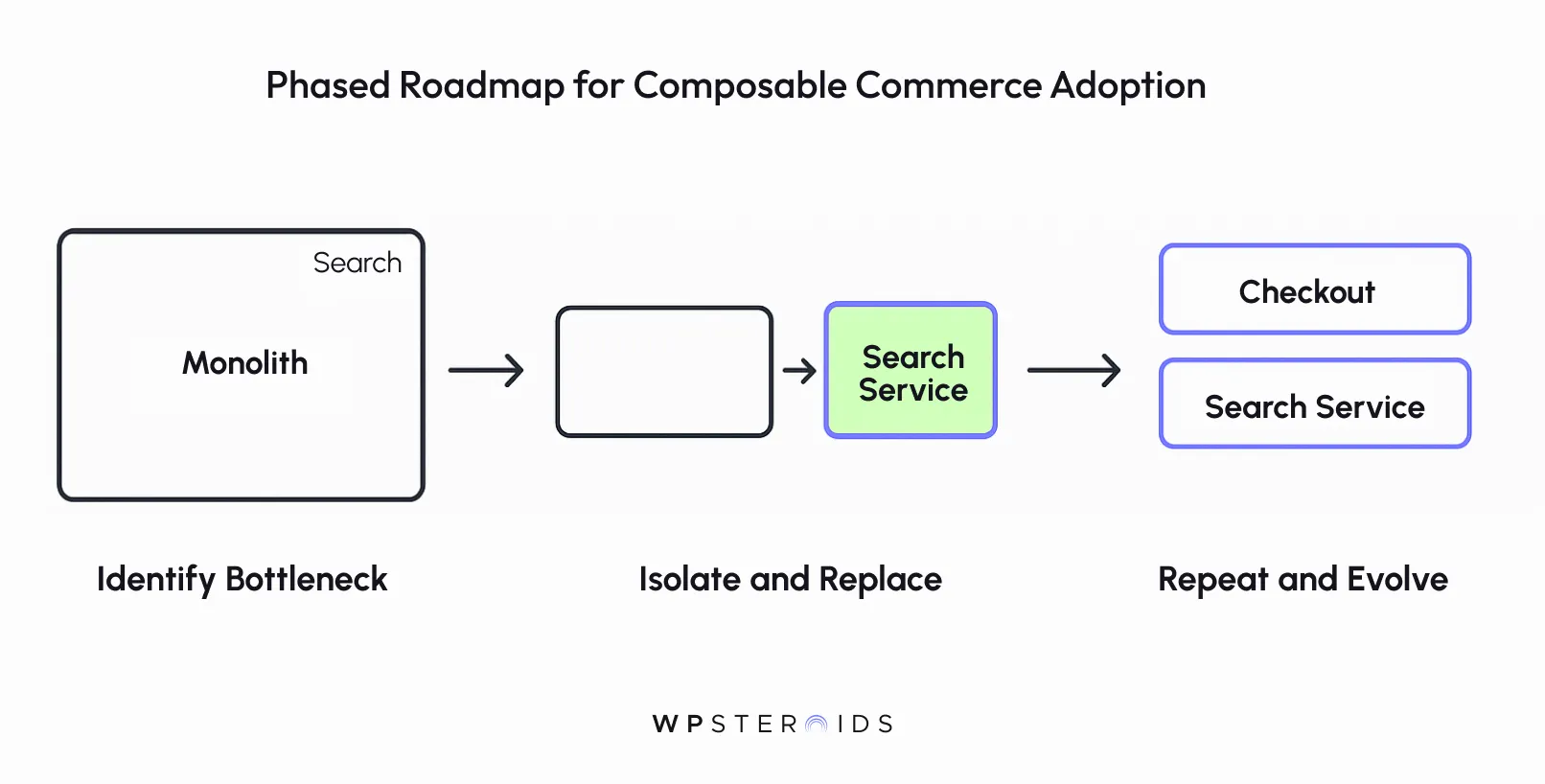
You can then repeat this process for the next biggest bottleneck, gradually and safely migrating functionality away from the legacy system over time.
In a composable world, your mindset shifts from having a single "vendor" to curating an ecosystem of strategic "partners." Your vendor selection process is less about finding one company that does everything tolerably and more about finding multiple companies that are the absolute best at what they do.
As you evaluate potential partners, prioritize those who are true adherents to MACH principles (Microservices, API-first, Cloud-native, Headless). This ensures their solutions are designed for the flexibility and interoperability you need.
Their role is to be the "general contractor," ensuring all the best-of-breed services work together seamlessly to execute your business logic and deliver a cohesive customer experience.
As you execute your roadmap, keep these key principles in mind to ensure a smooth and successful transition:
A move to composable commerce is a significant strategic decision, and it would be a disservice to pretend it comes without challenges.
While the benefits are transformative, a successful transition requires a clear-eyed understanding of the potential hurdles.
Being prepared for these complexities is the best way to mitigate them and ensure your investment pays off. These are not reasons to avoid a composable approach, but realities to plan for.
Let's be direct: while the analogy of "Lego blocks" is helpful for understanding modularity, it can oversimplify the initial effort.
The key challenges in implementing this model involve:
The most effective way to manage these implementation complexities and costs is to embrace the phased roadmap. Your first "start small" project serves as your training ground.
You build the orchestration muscle on a manageable scale, and the ROI from that first win helps fund the next phase. This turns a potentially overwhelming transformation into a series of controlled, value-generating steps.
For any B2B enterprise, security is non-negotiable. The idea of data flowing between multiple cloud services can naturally raise concerns about creating a larger attack surface.
How do you maintain robust security compliance and data governance when you don't have a single throat to choke?
Paradoxically, a composable architecture can often lead to a stronger security posture. Here's why:
This transformation is as much about people and processes as it is about technology. You are moving your team from a world of slow, waterfall-style release cycles to an agile, iterative mindset. This requires effective change management.
Your team's roles will evolve:
This can be a significant cultural shift. It’s crucial to frame this not as a burden, but as an opportunity for professional growth. Your team gets to work with modern, best-in-class tools, which can be a powerful tool for retaining and attracting top talent.
To bridge any initial skills gaps, lean on your system integration partner for expertise and training, and empower your internal team by giving them ownership of a small, manageable project first.
Let them build confidence and see the power of this new way of working firsthand.
These real-world examples illustrate how a modular approach moves from a concept to a tangible competitive advantage.
The Company: A well-established manufacturer of specialized industrial valves and fittings.
The Problem: Their business relied on two very different customer segments, and their rigid, monolithic platform served neither of them well.
The Composable Solution: They adopted a headless approach. Instead of trying to force one front-end to serve two masters, they built two, both powered by the same back-end commerce engine.
The Result: They were able to create the perfect, tailored experience for both audiences from a single source of truth. The efficiency of the wholesale channel skyrocketed, freeing up sales reps to focus on relationships instead of data entry. More importantly, the D2C channel saw a 300% increase in online revenue in the first year because the buying experience was finally frictionless.
The Company: A major distributor of electronic components with a catalog of over two million SKUs from hundreds of vendors.
The Problem: Their entire business hinged on product discovery. Their customers—mostly engineers and procurement specialists—needed to find components based on highly specific, technical attributes. Their monolithic platform’s built-in search was slow, inaccurate, and couldn't handle faceted filtering, causing immense frustration. To make matters worse, different customers had different contract terms and access to different product subsets. The platform's inability to personalize the catalog meant customers were often seeing products they couldn't buy or prices that weren't theirs.
The Composable Solution: They took a phased approach, focusing first on the single biggest bottleneck: search and personalization.
The Result: The impact was immediate and profound. Engineers could now find the exact component they needed in seconds instead of minutes or hours. Search-related customer support tickets dropped by over 60%. Because users were finding what they needed and discovering related components more easily, the average order value increased by 15% within the first six months. This clear, measurable ROI gave the team the political capital and funding to move on to the next phase: modernizing their checkout process.
We've covered a lot of ground, moving from the shared frustration of being trapped by a rigid, monolithic platform to a clear, pragmatic path forward.
The evidence is undeniable—from the hard data showing massive market adoption to the real-world case studies of B2B leaders driving transformative results.
The conclusion is clear: the shift from all-in-one systems to flexible, composable architectures is no longer a forward-thinking experiment. It is a strategic necessity for survival and growth in the modern B2B landscape. The future of B2B eCommerce is not about buying another one-size-fits-all platform; it's about building your own perfect-fit solution.
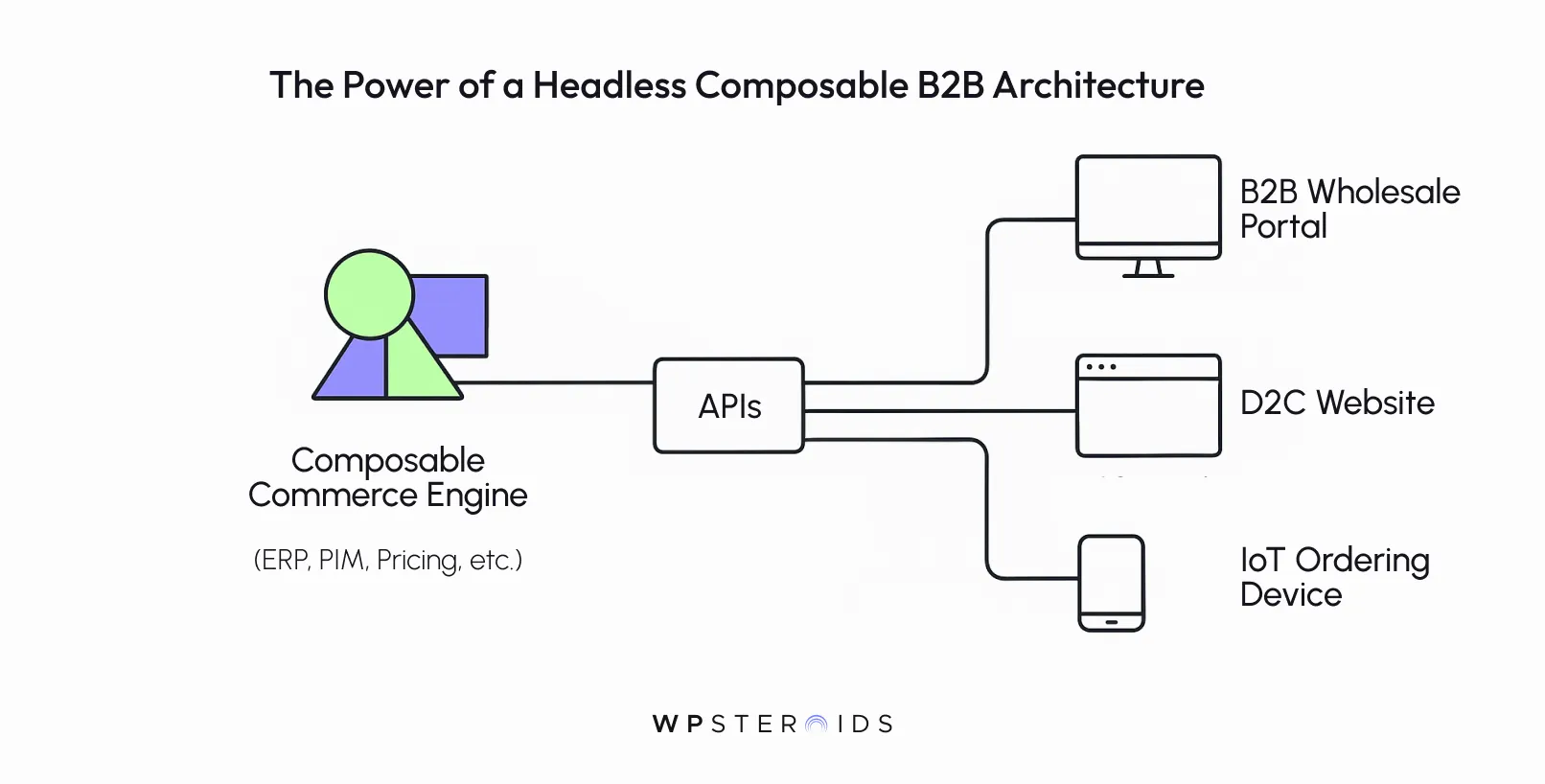
The core message is one of empowerment. Composable commerce is the future because it hands control back to you, the business leader. It provides the framework to finally build for resilience in an unpredictable world.
You know the pain of having your strategy dictated by your platform's limitations. The endless workarounds, the missed opportunities, the constant feeling of being one step behind. That era can now be over.
It’s time to stop letting your technology be the anchor. It’s time to build an engine. Take control of your digital future and build the exact B2B commerce experience your customers demand and your business deserves.
Ready to start the conversation? Book your discovery call today.